Views: 0 Author: Site Editor Publish Time: 2026-11-09 Origin: Site
Engineers frequently conflate temperature ratings with dielectric thickness during the design phase. This creates severe procurement errors in motor and transformer manufacturing. Specifying incorrect wire parameters leads directly to catastrophic outcomes on the test bench and in the field. You might see premature failure from thermal breakdown if the class is too low. You could face spatial fit issues in the stator slot if the build is too thick. Unexpected manufacturing bottlenecks often occur during termination when stripping requirements are misunderstood.
We must decouple these two metrics to prevent structural failures. You need a rigorous technical framework for evaluating and specifying the correct enameled winding wire. This ensures high reliability and optimal slot fill. It guarantees compliance with NEMA MW 1000 or IEC 60317 standards. It also keeps manufacturing efficient by aligning raw material properties with your specific winding and termination equipment.
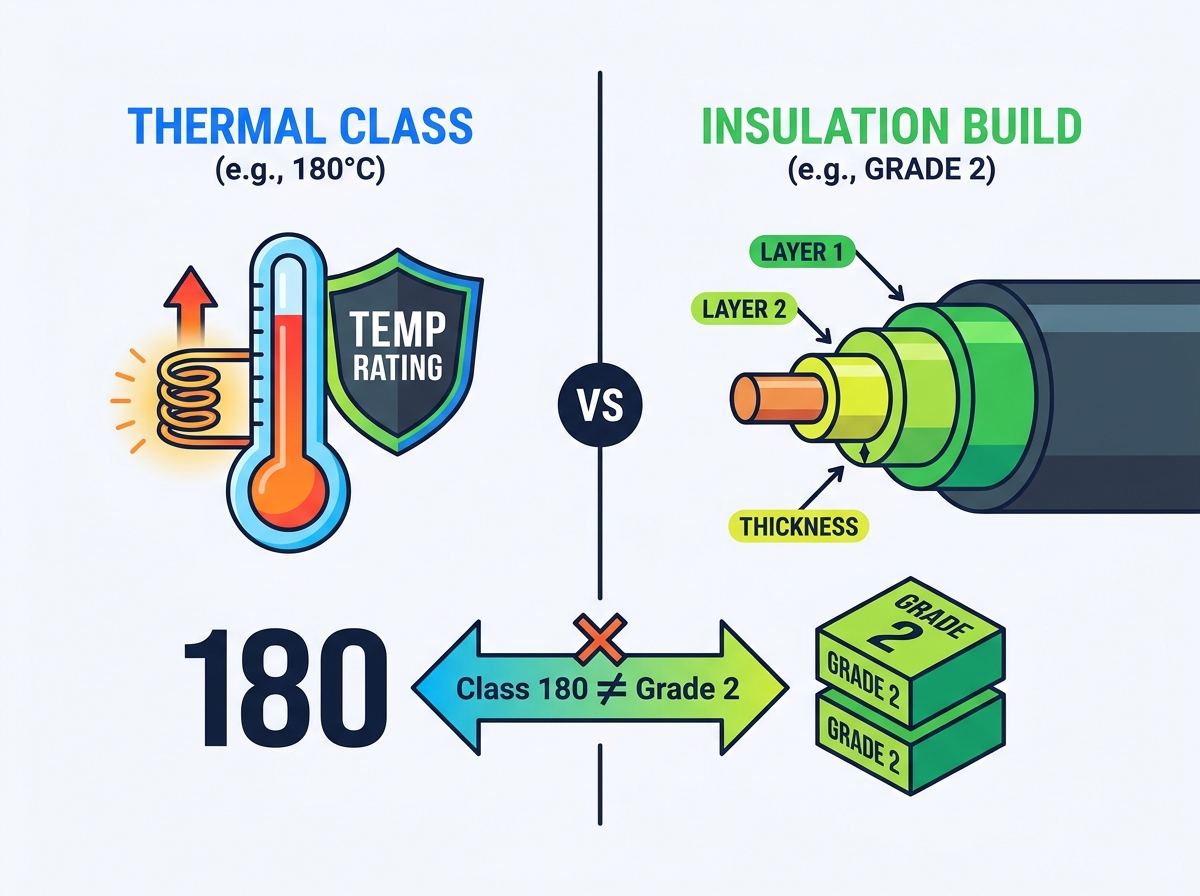
Distinct Metrics: Thermal class dictates the maximum continuous operating temperature (e.g., 180°C), while insulation build dictates the physical thickness and dielectric strength of the coating (e.g., Grade 2 / Heavy).
The Core Misconception: "Class 180" and "Grade 2" measure entirely different physical properties; a wire can be Class 180 Grade 1, or Class 155 Grade 2. They are not interchangeable terms.
Performance Trade-offs: Increasing insulation build improves dielectric protection but reduces the slot fill factor, requiring precise dimensional evaluation during the design phase.
Manufacturing Impact: Higher thermal classes often utilize polymers that cannot be directly soldered, requiring mechanical or chemical stripping, whereas lower classes (like 155°C polyurethane) offer direct solderability.
Standardization Variances: Navigating the terminology differences between NEMA (Single/Heavy/Triple) and IEC (Grade 1/2/3) is critical for global supply chain accuracy and quality assurance.
Success criteria in coil design require solid engineering definitions. You must read manufacturer datasheets accurately to avoid specification errors. The industry relies on specific testing methodologies to classify wire performance. Understanding these baselines prevents critical design failures before production begins.
Thermal class relies on the Arrhenius 20,000-hour life curve. This mathematical model predicts polymer degradation over time under specific heat loads. Engineers test wire samples at highly elevated temperatures, such as 250°C or 275°C, and plot the failure points on a logarithmic graph. They extrapolate this data to find the temperature at which the insulation will survive for 20,000 hours. Common thermal classes include 130, 155, 180, 200, 220, and 240. The magnet wire thermal class indicates the chemical stability of the film. It shows how the polymer handles continuous heat. It does not indicate thickness or voltage resistance.
Different polymers behave differently under thermal stress. Polyurethane typically maxes out at Class 155. Polyester often hits Class 180. Polyamide-imide and polyimide reach Class 200 to 240. Thermoplastic flow is a secondary metric tied directly to thermal class. Also known as cut-through temperature, this measures the point where the heated polymer softens enough to allow conductors to short under mechanical pressure. During a cut-through test, two crossed wires under a specific load are heated until they short out. This simulates wires crossing in a tight stator slot under thermal expansion. High thermal classes resist cut-through at much higher temperatures.
Insulation build is the radial thickness of the coating. This enameled wire insulation applies directly to bare copper or aluminum conductors through multiple passes in an enameling oven. A Heavy build is not just one thick coat. It consists of many thin passes through the enamel bath and curing dies. This builds concentricity and prevents pinholes. Regional standards dictate the terminology. NEMA uses terms like Single, Heavy, Triple, and Quad. IEC uses Grade 1, Grade 2, and Grade 3.
The build provides dielectric strength. It dictates the voltage withstand capability per mil of thickness. It also provides mechanical abrasion resistance during the winding process. A thicker build absorbs more physical abuse from winding nozzles and stator slot edges. Evaluating heat and thickness requires looking at them as independent variables.
Industry shorthand causes persistent confusion. Procurement and design failures happen when teams mix terminology. Engineers often use "Class 180" and "Grade 2" in the same breath, assuming they represent a single performance tier.
Purchase orders often read "MW 35-C Heavy" or "IEC 60317-51 Grade 2". The first part defines the standard and polymer chemistry. The second part defines the thickness. Engineers sometimes assume a higher thermal class automatically includes thicker insulation. They think a higher number always means better overall performance. This assumption is false. A Class 220 wire can have a Single build, making it highly vulnerable to voltage spikes despite its extreme heat resistance.
Specifying the wrong combination leads to three common failure scenarios on the production floor.
Scenario A: Specifying Class 180 when Grade 2 was actually needed. The wire possesses excellent thermal resistance. However, it has inadequate dielectric strength. Turn-to-turn shorts occur immediately during high-voltage testing or surge testing. The thin coating cannot withstand the potential difference between adjacent turns in a random wound coil.
Scenario B: Specifying Grade 2 when Class 180 was actually needed. The wire provides excellent voltage protection. Unfortunately, the polymer melts. Operational heat loads destroy the coating, leading to a catastrophic phase-to-phase short. The thick insulation acts as a thermal blanket, trapping heat and accelerating the chemical breakdown of the underrated polymer.
Scenario C: Over-specifying both class and build. You incur unnecessary material costs. The thicker wire reduces copper density in the winding. Motor efficiency drops due to higher resistance from smaller bare conductors. You also pay a premium for high-temperature polymers that your application never actually reaches.
You must weigh physical, electrical, and manufacturing demands carefully. Each application requires a specific balance of heat resistance, dielectric strength, and physical dimensions.
Evaluate continuous operating temperatures against peak transient loads. Motors often experience locked-rotor conditions that spike internal temperatures rapidly. Factor in ambient temperature and external cooling mechanisms. Check insulating varnish compatibility. Some varnishes cure at temperatures that can damage lower-class enamels. If you dip a stator wound with Class 130 wire into a varnish that requires a 160°C bake cycle, the enamel will degrade before the motor ever leaves the factory. The chemical interaction between the resin and the wire coating must remain stable over decades of operation.
Assess voltage spikes thoroughly. Inverter-duty motors driven by Variable Frequency Drives (VFDs) experience high dV/dt. Pulse Width Modulation creates standing waves. A standard 480V motor might see 1500V spikes at the motor terminals. These rapid voltage changes create corona discharge. They require thicker builds like Heavy or Triple. They also demand Corona-Resistant (CR) enamels filled with inorganic nanoparticles. These metal oxides dissipate the localized plasma discharge, preventing the enamel from eroding.
Evaluate mechanical stresses during coil winding. Elongation, scrape resistance, and winding tension matter. Automated winding machines pull wire at high speeds. The enamel must stretch with the copper without cracking. Thicker builds provide a larger safety margin against scrape damage from tooling.
Thicker insulation reduces active copper space. Grade 2 or 3 builds take up valuable slot room. You face a strict mathematical trade-off. If you switch from AWG 18 Single to AWG 18 Heavy, the overall diameter increases by roughly 1.5 to 2 mils. Multiply that by 100 turns in a slot, and you lose significant cross-sectional area. Calculate the impact on motor efficiency. I²R losses increase if copper density drops, because you are forced to use a smaller gauge wire to fit the same number of turns. Thermal dissipation also changes. Thicker enamel acts as a thermal barrier, trapping heat inside the copper conductor.
Standard | Build Designation | Relative Thickness | Primary Application |
|---|---|---|---|
NEMA | Single | Thinnest | Space-constrained coils, low voltage relays |
IEC | Grade 1 | Thinnest | Small fractional motors, standard transformers |
NEMA | Heavy | Medium | Standard industrial motors, high durability needs |
IEC | Grade 2 | Medium | General purpose winding, moderate electrical stress |
NEMA | Triple / Quad | Thickest | Inverter-duty motors, severe environments |
IEC | Grade 3 | Thickest | High voltage spikes, heavy mechanical winding stress |
Thermal class directly impacts the termination process. Solderable enamels, like Class 130 to 155 Polyurethane, allow direct soldering. The heat of the solder bath vaporizes the enamel, acting as a flux. High-temp enamels, like Class 180 to 220 Polyester or Polyamide-imide, will not melt in a standard solder pot. They require mechanical stripping with rotary wire brushes. Chemical stripping using harsh acids or laser ablation are alternative methods. Choosing a high thermal class without planning for the stripping process halts production lines. If the mechanical stripping wheel is set too tight, it nicks the copper, creating a stress riser that fails under vibration.
Use a step-by-step methodology for procurement and design teams. Finalizing wire specifications requires moving through four distinct evaluation gates to balance magnet wire thermal class vs insulation build.
Match the thermal class to the motor or transformer insulation system. Industry standards group components into specific temperature ratings. Class F systems operate at 155°C. Class H systems operate at 180°C. Class N systems operate at 200°C. Your wire must meet or exceed the rating of the weakest component in your insulation system. Do not mix a Class H wire with a Class B slot liner.
Select the insulation build based on operating voltage. Decide between Single/Grade 1 and Heavy/Grade 2. Random wound stators require thicker builds because adjacent wires may have high voltage potential differences. Form wound coils often use thinner builds wrapped in mica tape. Inverter exposure always dictates thicker builds to combat transient spikes.
Verify polymer chemistry against environmental hazards. Polyesterimide with a Polyamide-imide overcoat resists harsh environments well. Assess exposure to ATF fluids, refrigerants, moisture, and transformer oils. Hermetic compressors require specific enamels that will not degrade in Freon. Weak enamels blister and flake off when exposed to aggressive industrial solvents.
Balance raw material costs against production efficiency. Higher thermal classes and thicker builds cost more per pound. They also introduce hidden manufacturing costs. Mechanical stripping takes time and requires consumable brushes. Winding speeds may slow down to accommodate stiffer wire. Scrap rates can increase if the thicker wire jams in the winding nozzle. Optimize the specification to maximize yield without over-engineering the component.
Transitioning wire specs on the production floor carries inherent risk. You must ensure inbound quality matches the engineering intent.
Sourcing wire globally introduces conflicting terminology. IEC, NEMA, and JIS standards differ slightly in their dimensional tolerances. Relying on shorthand causes supply chain failures. Always specify the exact thermal class in degrees Celsius. Specify the exact dimensional build in millimeters or reference specific AWG dimensional tables. Clear documentation prevents suppliers from substituting incompatible materials.
Upgrading from Grade 1 to Grade 2 increases the outer diameter. This small change causes major issues. Wire jams in automated winding nozzles. Slot fill becomes too tight. Conduct a pilot winding run before full-scale production. Adjust tensioners to handle the new wire stiffness. Modify tooling and slot liner dimensions to accommodate the increased OD.
Mislabeled wire compromises the end product. Implement strict inbound QA protocols. Use calibrated micrometers to verify insulation build thickness. Subtract the bare copper diameter from the overall OD to confirm the grade. Conduct tangent delta testing to verify enamel cure states. Perform cut-through testing to verify thermal class properties. Never assume the spool label is perfectly accurate without sample verification.
Evaluating heat and thickness is not an either/or comparison. Both metrics must be independently calculated, tested, and specified to ensure component reliability. A failure in either dimension guarantees a failure in the field. Use thermal class to solve for heat, chemical degradation, and solderability. Use insulation build to solve for voltage stress, abrasion, and slot fill. Keeping these functions separate clarifies the design process.
Consult NEMA MW 1000 or IEC 60317 dimensional tables to verify exact outer diameters before finalizing slot designs.
Request detailed manufacturer datasheets to confirm polymer performance under specific chemical exposures and varnish curing temperatures.
Perform accurate slot fill calculations based on the maximum allowable outer diameter of the chosen build.
Run a pilot winding test to calibrate tensioners and tooling before releasing the specification to full production.
A: Grade 1 and Grade 2 refer to the radial thickness of the enamel coating. Grade 2 is thicker than Grade 1. This increased thickness provides higher dielectric strength and superior abrasion resistance. It is essential for applications facing higher electrical or mechanical stress during winding.
A: No. Thermal class refers exclusively to the polymer's temperature resistance and chemical stability over a 20,000-hour lifecycle. It does not indicate physical thickness. You can have a high thermal class wire with a very thin insulation build.
A: Substituting these carries significant risk. Class 200 handles more heat than Class 180, but Grade 1 has a lower dielectric strength than Grade 2. In high-voltage applications, the thinner Grade 1 coating may lead to electrical shorts, even if it survives the heat.
A: Engineers measure the overall outer diameter (OD) using a calibrated micrometer. They then subtract the bare conductor diameter from this measurement. The resulting value is compared against standard AWG or metric dimensional tolerance tables to confirm the build grade.
A: Yes. Lower thermal classes, like 155°C polyurethane, melt at standard soldering temperatures. This allows for direct termination. Higher thermal classes, such as 180°C polyester or 200°C polyamide-imide, resist heat. Their insulation must be mechanically or chemically stripped before soldering.
A: A build that is too thick reduces the slot fill factor. This limits the amount of active copper you can insert. Forcing thick wire into a tight slot damages the insulation. It also decreases motor efficiency due to higher electrical resistance from using smaller copper conductors.
A: They are functionally equivalent for general dielectric purposes in the industry. However, they are not identical. Specific dimensional tolerances, testing methodologies, and minimum build requirements vary slightly between NEMA MW 1000 and IEC 60317 standards. Always verify dimensions.