Views: 0 Author: Site Editor Publish Time: 2026-08-22 Origin: Site
High-voltage transformers, large motors, and specialized electrical equipment require precise material specification to prevent thermal degradation and electrical failure. Engineering and procurement teams must balance strict space constraints, weight limitations, and raw material availability without compromising the dielectric strength or thermal class of the winding. Operating environments demand robust solutions that can withstand extreme thermal cycling, mechanical vibration, and chemical exposure over decades of continuous service. While Nomex insulation provides a consistent high-temperature dielectric barrier, the choice between copper and aluminum conductors dictates the physical footprint, mechanical durability, and overall system viability. Selecting the wrong conductor material can lead to oversized enclosures, excessive structural loads, or premature joint failure. This guide provides a framework for evaluating which conductor material aligns with specific project requirements, ensuring optimal performance and reliability in demanding electrical applications.
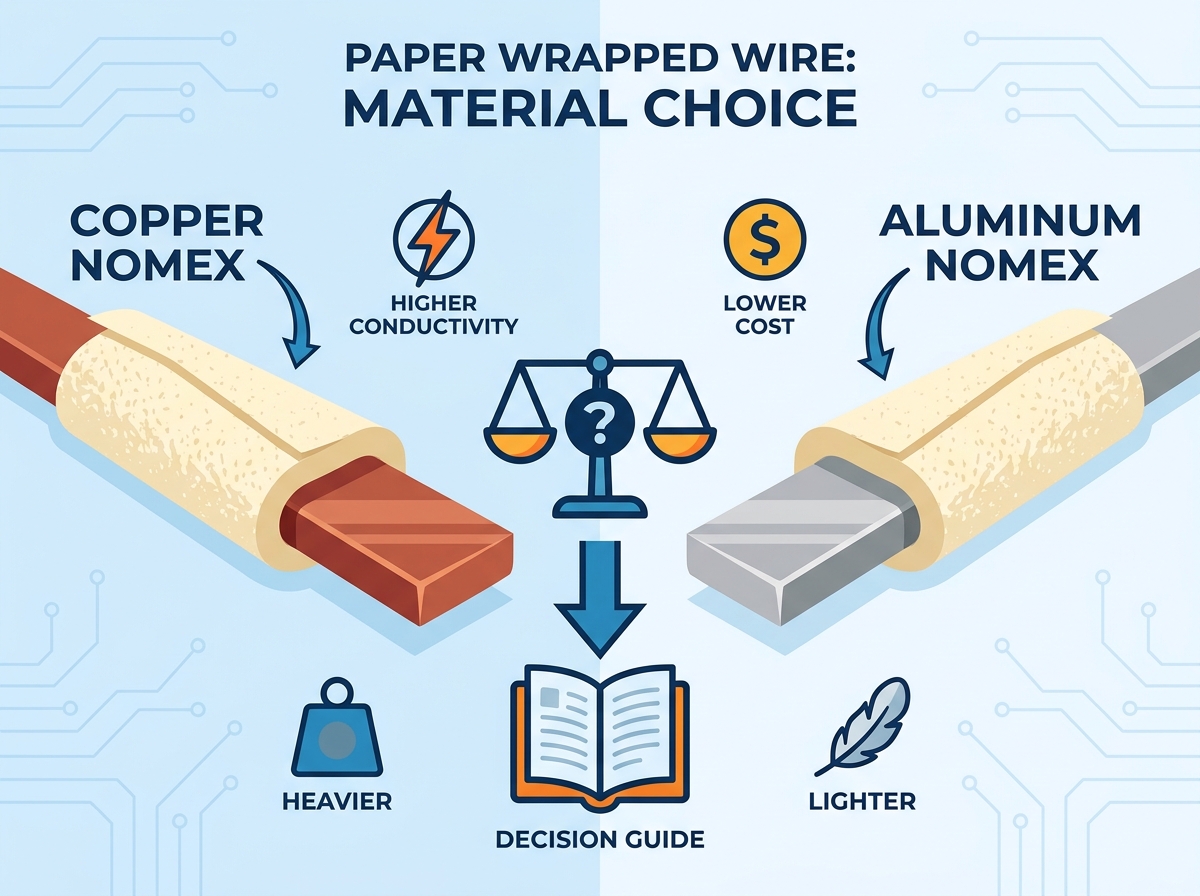
Space vs. Weight Trade-off: Copper offers superior conductivity, requiring a smaller cross-section for space-constrained designs, while aluminum provides significant weight reduction for large-scale applications.
Thermal Consistency: Regardless of the conductor choice, Nomex paper wrapped wire delivers exceptional thermal stability (typically Class 220°C) and resistance to chemical degradation.
Mechanical Realities: Aluminum requires specialized termination and jointing techniques to prevent galvanic corrosion and thermal expansion failures, whereas copper offers higher tensile strength for high-stress winding processes.
Cost Predictability: Aluminum generally offers lower and more stable raw material costs, offsetting the need for larger winding windows in specific transformer and motor designs.
Electrical insulation in harsh environments faces extreme demands. Windings must survive high operating temperatures and constant mechanical stress. They also endure prolonged exposure to transformer oils, synthetic coolants, and environmental contaminants. Standard insulation materials often degrade under these conditions, losing their dielectric properties and becoming brittle. Engineers need a reliable dielectric barrier to prevent short circuits and catastrophic equipment failure. The insulation must maintain integrity during the rigorous winding process, where it is subjected to tension, bending, and abrasion. It must also resist chemical breakdown over decades of continuous operation, ensuring the equipment meets its designed lifecycle without requiring premature rewinding or replacement.
Success in these applications requires an insulation system that does not compromise under thermal overload conditions. When a transformer experiences a surge or a motor operates near its maximum load, the internal temperature spikes. The insulation must not melt, flow, or carbonize. It must retain its mechanical strength to keep the conductors separated and prevent turn-to-turn faults. This baseline requirement eliminates many conventional polymer films and standard cellulose papers, driving the industry toward advanced aramid materials for critical infrastructure.
Nomex, an aramid paper, offers significant advantages over standard Kraft paper. It provides an exceptional thermal rating, typically classified as Class H (220°C). This allows equipment to operate safely at higher temperatures without insulation degradation. Nomex also delivers inherent flame resistance. It does not melt or support combustion in the air, providing a critical safety margin in the event of an internal fault. Furthermore, it boasts superior dielectric breakdown strength. This ensures reliable electrical isolation even under high-voltage stress, allowing designers to use thinner insulation layers compared to traditional materials.
The chemical stability of Nomex is another crucial factor. It is highly resistant to moisture absorption, which is a common cause of dielectric failure in standard paper insulation. Moisture lowers the breakdown voltage and accelerates thermal aging. Nomex maintains its electrical properties even in high-humidity environments. It is also compatible with a wide range of transformer oils, varnishes, and encapsulating resins. This compatibility ensures that the insulation system functions as a cohesive unit, without adverse chemical reactions that could compromise the dielectric barrier over time.
Manufacturers heavily utilize flat, or rectangular, wire profiles in large electrical equipment. Flat wire provides a significantly higher slot fill factor than round wire. This means more conductive material fits into the same physical space. It eliminates the empty voids inherent in stacking round conductors, maximizing the efficiency of the magnetic circuit. Flat profiles also offer better heat dissipation. The larger surface area transfers heat more efficiently to the surrounding oil or air, reducing the internal hot spot temperature of the winding.
Additionally, rectangular conductors reduce the skin effect in high-frequency applications. This improves overall electrical efficiency by ensuring a more uniform current distribution across the conductor cross-section. In large power transformers, the use of continuously transposed cable (CTC), which consists of multiple insulated rectangular strands, further reduces eddy current losses. The flat profile is essential for constructing these advanced conductor configurations, enabling higher efficiency and better thermal management in high-capacity equipment.
Wrapping insulation around rectangular conductors presents unique challenges. The material must navigate sharp, 90-degree edges without tearing or thinning. Nomex paper excels in this area. It possesses excellent mechanical flexibility and foldability. Machines can wrap it cleanly around flat profile edges. It conforms tightly without micro-tearing or compromising the dielectric barrier. This ensures uniform insulation thickness across the entire conductor surface, preventing weak points where electrical stress could concentrate.
Standard papers often crack under similar bending stress, leading to premature electrical faults. The aramid fibers in Nomex provide a tough, resilient matrix that withstands the mechanical rigors of the taping process. During manufacturing, the paper is applied with precise tension and overlap to create a continuous, multi-layered dielectric shield. The ability of Nomex to stretch slightly and conform to the conductor geometry ensures a tight, void-free wrap. This is critical for preventing partial discharge, a phenomenon where localized electrical breakdown occurs in microscopic air gaps, eventually eroding the insulation and causing failure.
Conductivity is the primary metric when evaluating conductor materials. Aluminum possesses roughly 61% of the conductivity of copper. This fundamental difference drives major design decisions. To achieve the same current-carrying capacity, an aluminum conductor requires a larger physical size. Specifically, you must use a cross-sectional area approximately 1.6 times larger than copper. This physical reality dictates the entire geometry of the electrical apparatus.
This size difference directly impacts the core size of transformers and stators. A larger conductor requires a larger winding window. This increases the overall footprint of the equipment. It often necessitates larger physical enclosures, more core steel, and increased volumes of insulating oil. You may also need wider raceways or conduits to accommodate the bulkier wire. When space is strictly limited, such as in underground vaults or compact industrial machinery, copper remains the superior choice. The increased volume required for aluminum can make it impossible to fit the necessary capacity into a restricted dimensional envelope.
Weight is another critical evaluation dimension. Aluminum is significantly lighter than copper. The specific gravity of aluminum is roughly 30% that of copper. This massive weight reduction offers distinct advantages for large-scale equipment. When designing massive power transformers or large industrial motors, the weight of the active materials constitutes a major portion of the total unit mass.
Specifying copper or aluminum Nomex covered wire drastically impacts structural design. Lighter aluminum windings reduce the mechanical load on the equipment housing. This allows for lighter support structures, thinner tank walls, and less robust foundations. It also significantly lowers transportation costs and simplifies rigging requirements. Installation logistics become easier and safer when maneuvering lighter transformer cores or motor stators. In applications where weight limits are strictly enforced, such as offshore platforms or mobile substations, the weight savings provided by aluminum can be the deciding factor.
The winding process subjects conductors to high mechanical tension. Yield strength differences between the two metals are substantial. Copper withstands much higher tension during winding without stretching. It maintains its cross-sectional integrity under heavy mechanical stress. This makes copper ideal for tight, complex winding patterns where the conductor must be pulled firmly into place to achieve the required slot fill and mechanical rigidity.
Aluminum is softer and has lower tensile strength. It carries a higher risk of cross-sectional thinning during the winding process. If winding tension is not strictly calibrated, the aluminum conductor can stretch. This reduces its cross-sectional area and increases localized electrical resistance, creating hot spots during operation. Manufacturers must use precise tension control equipment when winding aluminum coils. The winding machines must be equipped with sensitive feedback loops to ensure the tension remains within the elastic limit of the aluminum, preventing permanent deformation and maintaining the designed electrical characteristics of the coil.
Property | Copper Conductor | Aluminum Conductor |
|---|---|---|
Conductivity | Baseline (100% reference) | Approx. 61% of Copper |
Cross-Sectional Area Needed | Baseline (1.0x) | Approx. 1.6x larger |
Weight (Specific Gravity) | Heavier (8.96 g/cm³) | Lighter (2.70 g/cm³) |
Tensile Strength | High (resists stretching) | Lower (requires tension control) |
Oxidation Rate | Slow (conductive oxide) | Rapid (insulating oxide) |
Copper is the default choice for applications with strict dimensional constraints. Compact traction transformers rely heavily on copper conductors to fit within the limited space available on locomotives and railcars. High-efficiency industrial motors also require the dense slot fill that copper provides to maximize power output within a standard frame size. When the physical footprint cannot expand, copper is mandatory to achieve the required electrical performance.
Copper is also necessary for environments subjected to high mechanical vibration. It performs better under severe short-circuit stresses. The superior tensile strength of copper prevents winding deformation during fault conditions, where immense electromagnetic forces attempt to push the conductors apart. Heavy industrial applications, steel mills, and railway systems typically specify copper for these exact reasons. The robust mechanical nature of copper ensures the windings remain secure and intact, preventing catastrophic failure during transient fault events.
Aluminum shines in weight-sensitive applications. Pole-mounted distribution transformers benefit greatly from reduced weight, minimizing the structural load on utility poles and simplifying installation for line crews. Aerospace applications also prioritize aluminum to minimize payload mass, where every kilogram saved translates to increased efficiency and range. Whenever structural support is a limiting factor, aluminum offers a clear advantage.
Large-scale utility projects frequently utilize aluminum conductors. In these scenarios, the physical footprint is rarely restricted. Substations have ample space for larger transformer enclosures. Budget constraints and material weight become the primary concerns. Aluminum provides the necessary electrical performance while significantly reducing the overall mass of the unit. This makes transportation to remote sites feasible and reduces the required capacity of lifting cranes during installation. For large power transformers where space is abundant, aluminum is a highly practical and efficient choice.
Procurement teams must navigate complex commodity markets. Aluminum historically offers stable and predictable raw material costs. Copper markets experience much higher volatility and frequent price spikes driven by global demand and supply chain disruptions. This makes aluminum highly attractive for long-term project forecasting, allowing manufacturers to quote large projects with greater confidence in their material costs.
However, raw material cost is only one part of the equation. Aluminum requires a larger volume of metal to match copper's performance. Consequently, it requires more Nomex paper to wrap the larger surface area. The increased insulation material, larger core steel requirements, and larger enclosure size alter the final unit cost. Engineers must calculate the complete bill of materials to determine actual savings. The upfront savings on the conductor must be weighed against the increased costs of the surrounding components required to accommodate the larger aluminum windings.
Market availability impacts project timelines. Standard copper flat wire profiles are widely available globally. Suppliers maintain large inventories of common copper sizes. This ensures rapid procurement and shorter lead times for standard designs, allowing manufacturers to respond quickly to urgent orders or unexpected equipment failures.
Aluminum flat profiles can sometimes present sourcing challenges. Specialized aluminum sizes may require custom extrusion runs. This can lead to longer procurement delays. Suppliers often enforce minimum order quantities for non-standard aluminum profiles. Procurement teams must factor these lead times into their production schedules. Planning ahead and establishing strong relationships with specialized magnet wire suppliers is crucial when specifying aluminum for custom or low-volume applications.
Aluminum presents specific implementation risks during termination. It oxidizes rapidly when exposed to air. This oxide layer is an electrical insulator, which can cause joint failure and dangerous overheating if not properly addressed. Aluminum is also susceptible to cold flow, or creep, under continuous pressure. When a standard mechanical connection is tightened, the aluminum can slowly deform over time, loosening the joint and increasing electrical resistance. Furthermore, galvanic corrosion occurs when aluminum mates with dissimilar metals like copper in the presence of an electrolyte, rapidly degrading the connection.
Engineers must implement strict mitigation strategies. Technicians must use specialized bi-metallic lugs for all connections transitioning from aluminum to copper. Compression fittings designed specifically for aluminum are mandatory, as they distribute the clamping force evenly and accommodate the metal's expansion characteristics. Installers must apply oxide-inhibiting jointing compounds before making connections. These compounds seal out oxygen and moisture, preventing the formation of insulating oxides. Proper torque controls ensure the joint remains secure without causing cold flow. Using Belleville washers can also help maintain consistent pressure on the joint despite thermal cycling.
Strip the insulation carefully without nicking the aluminum conductor.
Wire-brush the exposed aluminum immediately before making the connection to remove existing oxidation.
Apply a generous coating of oxide-inhibiting compound to the bare metal.
Install the appropriate bi-metallic lug or compression fitting.
Crimp or torque the connection to the manufacturer's exact specifications.
Handling flat wire requires careful attention to bending radii. Aluminum is softer and easier to bend than copper. However, it is more prone to nicking or breaking if bent repeatedly or if the bend radius is too tight. Technicians must avoid sharp, unradiused bends that stress the metal and create weak points that could fracture under operational vibration.
Maintaining the integrity of the paper wrapped wire is crucial. During tight corner bends, the insulation can slip or tear. Best practices require specialized bending tools that support the inner radius. This ensures the Nomex paper folds cleanly without exposing the bare conductor. Proper handling prevents dielectric failures at the winding corners. Operators must be trained to handle the spools carefully, avoiding any impact that could dent the wire or damage the paper wrapping before it even enters the winding machine.
Neither copper nor aluminum is universally superior for all applications. The optimal choice depends entirely on your specific hierarchy of design constraints. You must weigh space limitations against weight restrictions and budget parameters. Default to copper when efficiency, compact size, and standard conduit routing are non-negotiable. Default to aluminum when weight reduction and upfront material savings outweigh footprint limitations. Careful consideration of the mechanical and electrical properties of each metal ensures the final equipment meets all operational requirements.
Calculate exact slot fill requirements for your specific enclosure dimensions.
Review your facility's termination capabilities and tooling for aluminum conductors.
Request physical material samples from a certified magnet wire manufacturer for bend testing.
Audit your supply chain for lead times on specialized flat wire profiles.
A: Nomex paper wrapped wire typically supports Class 220°C (Class H) applications. It maintains its dielectric strength and mechanical integrity even at continuous high operating temperatures, making it ideal for heavy-duty transformers and motors.
A: An aluminum conductor requires approximately a 1.6x larger cross-sectional area to achieve the equivalent ampacity of copper. This impacts slot fill and often requires larger enclosures or wider conduits.
A: No, a direct 1:1 substitution is impossible. Because aluminum requires a larger cross-sectional area, the core, winding window, and terminal structures must be completely redesigned to accommodate the increased size.
A: Aluminum requires specialized bi-metallic connectors, oxide-inhibiting compounds, and strict torque controls to prevent creep and galvanic corrosion. Copper is significantly more forgiving and does not require these specialized termination protocols.
A: Flat wire provides a higher space factor, known as slot fill, compared to round wire. It also offers better heat dissipation and allows for more uniform stacking in high-voltage windings, improving overall efficiency.