Views: 0 Author: Site Editor Publish Time: 2026-08-28 Origin: Site
High-capacity and compact transformer designs increasingly demand winding materials that withstand extreme thermal loads without compromising dielectric integrity or footprint. As transformer ratings increase, engineers must balance the mitigation of eddy current losses and thermal hotspots against manufacturing complexity and material volume. Relying on standard insulation or suboptimal winding geometries leads to premature degradation or oversized core designs. Evaluating the structural and electrical differences between standard Nomex paper covered flat wire and Nomex-wrapped Continuously Transposed Conductors (CTC) is necessary for optimizing transformer efficiency, lifecycle, and operational reliability. We see many winding failures originating from incorrect material specification at the design phase. Selecting the right conductor geometry directly impacts the thermal gradient across the coil. You must evaluate the mechanical stresses your winding machines impose on the insulation during production to avoid hidden dielectric faults.
Nomex insulation elevates the thermal baseline of paper wrapped wire to Class H (180°C) and up to 220°C, significantly outperforming standard Kraft paper in high-load applications.
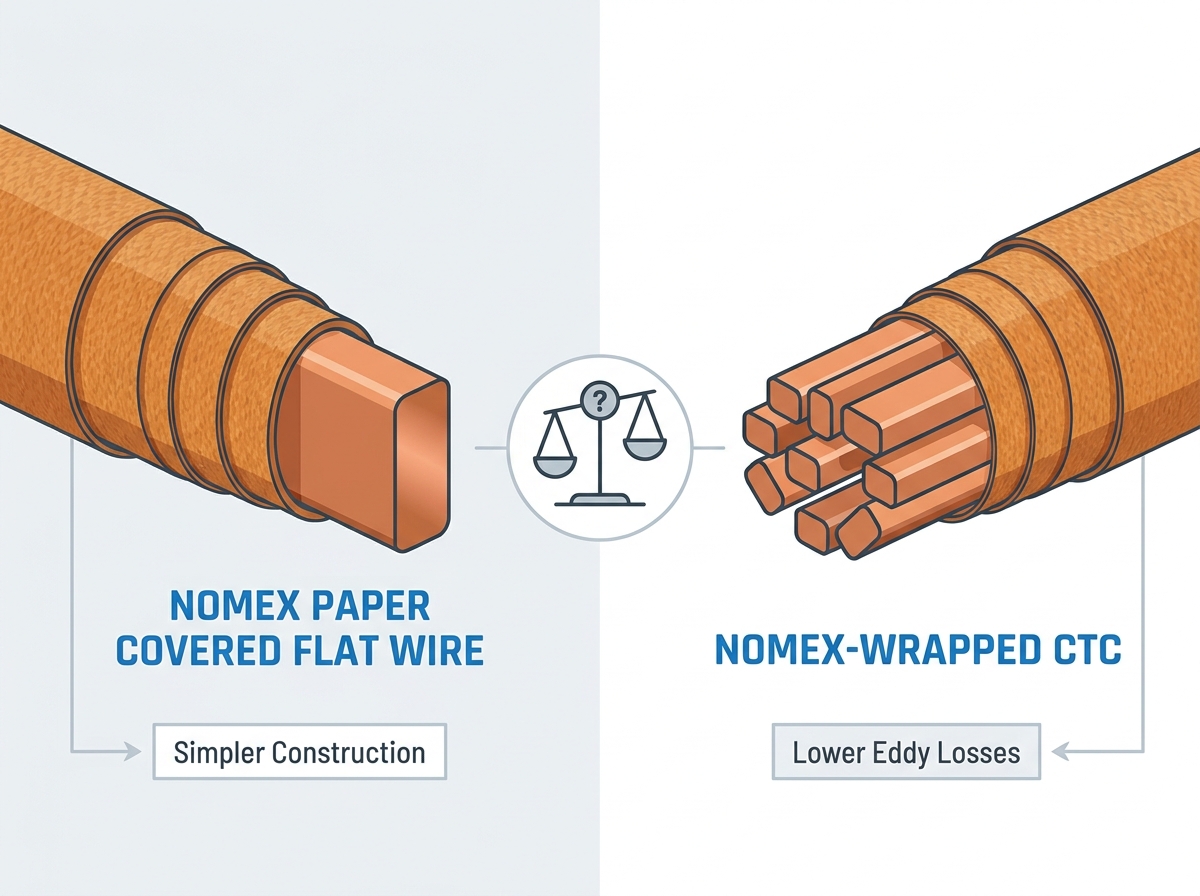
Nomex paper covered flat wire (often categorized under Paper Insulated Copper Conductors, or PICC) offers high mechanical stability and a mature manufacturing process, making it highly cost-effective for medium-voltage and standard dry-type transformers.
Nomex-wrapped CTC drastically reduces eddy current losses and improves space utilization (fill factor) in high-capacity power transformers, though it requires specialized winding handling and higher upfront material costs.
The decision between flat wire and CTC hinges on a strict cost-benefit analysis comparing initial procurement costs against long-term operational efficiency and footprint constraints.
Transformer engineers are shifting from standard cellulose-based Kraft paper to synthetic aramid-based Nomex paper. This transition fundamentally upgrades the thermal capacity of the winding. Nomex insulation achieves a Class H thermal rating of 180°C. It can sustain peak temperatures up to 220°C. This high thermal limit prevents thermal runaway during severe overload conditions. Standard Kraft paper degrades rapidly at these elevated temperatures, losing its mechanical strength and turning brittle. Nomex maintains its structural and dielectric integrity even after thousands of hours at elevated loads.
Breakdown voltage characteristics also improve significantly when using synthetic aramid fibers. Manufacturers apply Nomex in standard thickness ranges of 70 to 130 gsm. The exact thickness depends heavily on the specific design voltage and cooling requirements of the coil. Engineers often utilize a hybrid design for added safety. This involves combining enameled flat wire cores with an outer Nomex tape wrap. This dual-layer approach establishes robust dielectric protection. It prevents turn-to-turn shorts even under high electrical stress, such as lightning impulses or switching surges. We frequently specify this hybrid approach for traction transformers where vibration and electrical stress occur simultaneously.
Winding operations subject insulation to severe mechanical stress. Nomex tape provides exceptional tear resistance compared to standard paper wrapped wire. High tensile strength prevents the insulation from splitting during tight radius bending. Automated high-tension winding machines require this level of durability to maintain production speed without causing defects. Damaged insulation leads to immediate dielectric failure during routine factory acceptance testing.
Industry standards categorize these materials specifically to avoid confusion on the shop floor. Paper Insulated Copper Conductor (PICC) typically refers to standard flat or round wire wrapped in insulating tape. Continuously Transposed Conductor (CTC) represents a more complex bundled geometry used in larger units. Both configurations benefit immensely from the mechanical toughness of Nomex. The aramid fibers resist cutting and abrasion during core assembly, especially when operators are wedging the coils into the core window.
Inspect the tensioning blocks on the winding machine to ensure they do not score the outer paper layer.
Calibrate the bending mandrels to match the exact corner radius specifications of the flat wire.
Monitor the overlap percentage of the Nomex tape during the wrapping process to guarantee consistent dielectric thickness.
Perform a visual inspection of the conductor edges before winding to catch any burrs that might pierce the insulation from the inside out.
Nomex paper covered flat wire consists of single or bundled rectangular conductors. These copper or aluminum cores are tightly wrapped in layers of Nomex paper. Bare flat conductors rely entirely on the paper for insulation. Enameled flat conductors wrapped in Nomex provide superior dielectric margins. The enamel layer allows for thinner paper wrapping, which improves heat transfer out of the conductor.
Space utilization within the transformer window is a primary design metric. Flat wire offers a significantly higher fill factor compared to round wire. The rectangular geometry minimizes empty voids between turns. This efficient packing allows engineers to design smaller magnetic cores. A higher fill factor directly reduces the overall footprint of the unit, saving valuable space in substations and industrial enclosures.
Engineers specify flat wire for a variety of standard applications where extreme current ratings are not the limiting factor. Medium-voltage distribution transformers utilize this wire extensively due to its reliability and ease of winding. Standard dry-type transformers also rely on its thermal stability to handle fluctuating loads without active cooling systems. Wind turbine generators benefit from its resistance to thermal cycling, as the wind load varies constantly. Specific traction applications require its robust mechanical properties to survive constant vibration.
The supply chain for flat wire is highly mature and globally accessible. Predictable manufacturing processes ensure consistent quality and availability across different regions. Tooling costs for winding flat wire remain relatively low compared to specialized conductors. Standard winding machines handle flat wire without requiring expensive modifications or specialized operator training. This makes it a highly practical choice for medium-duty designs.
Solid flat wire faces strict limitations as alternating current ratings increase. The skin effect pushes the current to the surface of the conductor, reducing the effective cross-sectional area. The proximity effect distorts current distribution due to adjacent magnetic fields from neighboring turns. Both phenomena generate significant eddy current losses within solid conductors, which manifest as excess heat.
These losses become detrimental in high-capacity power transformers. Localized heating creates dangerous thermal hotspots that degrade the insulation over time. Engineers must quantify the threshold where solid wire becomes inefficient. Exceeding this threshold compromises the overall thermal profile of the transformer. At this point, alternative winding geometries become mandatory to keep temperatures within safe operating limits.
CTC features a highly specialized internal construction designed specifically to combat stray losses. It consists of multiple individually enameled rectangular strands. Manufacturers transpose these strands continuously along the length of the cable. The entire bundle is then wrapped under a shared outer Nomex paper layer. This complex geometry requires precision manufacturing equipment to ensure the strands do not pinch or short against each other during the transposition process.
The transposition pitch must be carefully calculated based on the magnetic field distribution of the specific transformer design. If the pitch is too long, the eddy current reduction is suboptimal. If the pitch is too short, the mechanical integrity of the bundle suffers, and the risk of internal strand damage increases. We always verify the transposition pitch during factory inspections to ensure it matches the design parameters.
The primary function of CTC is to eliminate circulating currents within the winding. Transposition equalizes the magnetic field exposure across every individual strand. Each strand occupies every possible position within the bundle cross-section over a specific length. This physical arrangement cancels out the induced voltages that cause eddy currents to flow between strands.
Reducing circulating currents drastically lowers localized heating. CTC eliminates the severe hotspots common in solid flat wire designs operating at high currents. Engineers expect a massive reduction in stray losses when upgrading from solid wire to CTC. This efficiency gain is vital for large power transformers operating at continuous full load, where every kilowatt of lost energy translates to wasted operational capacity.
CTC improves the overall winding fill factor even further than standard flat wire. The tight physical configuration of the enameled strands minimizes wasted space within the bundle. The shared outer Nomex wrap reduces the total insulation volume compared to wrapping multiple individual flat wires. This efficiency allows for more copper within the same window area, lowering the current density and reducing resistive losses.
High-voltage power transformers achieve smaller, lighter designs using CTC. Reducing the core size lowers the required volume of electrical steel, which is a major component of the overall weight. This weight reduction simplifies transportation and installation, especially for units destined for remote substations or offshore platforms. The improved space factor directly influences the final dimensions of the transformer tank, requiring less dielectric fluid to fill the unit.
Thermal dissipation profiles differ significantly between the two configurations. Solid flat wire concentrates heat at the conductor surface, relying entirely on the outer insulation to transfer heat to the cooling medium. CTC distributes heat more evenly across the multiple internal strands. The internal enamel of CTC strands facilitates efficient heat transfer within the bundle. The outer Nomex wrap allows heat to pass into the cooling medium without creating a massive thermal bottleneck.
We monitor the thermal gradient of both designs during temperature rise tests. CTC consistently shows a flatter temperature profile across the coil. Solid flat wire often exhibits a sharp temperature spike near the top of the winding where the axial magnetic flux is highest. Managing these hotspots requires careful placement of cooling ducts, which complicates the winding process and reduces the overall fill factor.
Mechanical rigidity during short-circuit faults is a primary concern for any transformer designer. Massive radial and axial forces attempt to deform the winding during a fault. Standard flat wire relies on winding tension, radial spacers, and axial bracing for stability. Epoxy-bonded CTC offers superior resistance to these dynamic forces. The internal epoxy cures during the drying process, creating a solid, immovable block that resists deformation.
Performance Metric | Nomex Paper Covered Flat Wire | Nomex-Wrapped CTC |
|---|---|---|
Eddy Current Losses | Moderate to High (in large designs) | Extremely Low |
Winding Complexity | Standard / Straightforward | High / Requires specialized handling |
Short-Circuit Strength | Good (relies on external bracing) | Excellent (especially with epoxy bond) |
Fill Factor | High | Very High |
Cooling Duct Requirement | Frequent radial ducts needed | Fewer ducts required due to lower losses |
Evaluating the operational efficiency requires looking at the entire lifespan of the transformer. Nomex-wrapped CTC requires a higher initial material investment due to the complex manufacturing process. However, the drastic reduction in load losses pays dividends over decades of continuous operation. Standard Nomex paper covered flat wire has a lower initial procurement barrier but will generate higher losses in high-current applications.
Engineers must calculate the capitalized value of these losses based on the specific load profile of the installation. For base-load generators running at 100% capacity, the efficiency gains of CTC easily justify the initial material investment. For standby or lightly loaded distribution units, standard flat wire remains the most logical choice. You have to run the loss evaluation formulas for every specific project to make an informed decision.
Winding CTC requires specific tooling and strict tension controls. Operators must not damage the internal strand transposition during the winding process. Excessive bending force can crush the internal strands, compromising the enamel and creating internal shorts. The outer Nomex tape layer must remain intact during all operations. Specialized expertise is necessary to form the winding leads correctly, as separating the strands for connections requires precision.
Flat wire presents relatively straightforward winding requirements. It tolerates standard bending radii without internal damage. Operators use standard tensioning devices without fear of crushing complex internal structures. The robust nature of solid flat wire reduces the risk of manufacturing defects during coil assembly. We find that facilities transitioning to CTC for the first time experience a learning curve that temporarily increases their defect rate.
Ensure winding machine operators receive specific training on handling transposed conductors.
Upgrade tensioning systems to provide smooth, consistent force without sudden jerks.
Implement strict quality control checks at the lead exit points where CTC is most vulnerable.
Use specialized bending tools designed specifically for the dimensions of the CTC bundle.
Maintain a clean winding environment to prevent metallic dust from settling on the Nomex paper.
Dry-type transformers utilize the Vacuum Pressure Impregnation (VPI) process to seal the windings. Nomex behaves exceptionally well during VPI. The porous nature of the paper allows the epoxy resin to penetrate fully. This creates a solid, void-free insulation system that resists moisture and mechanical vibration. Nomex also performs well in liquid-filled transformers. It shows excellent compatibility with both mineral oils and synthetic ester fluids.
Oil flow dynamics require careful consideration when designing the coil. Engineers must design adequate cooling ducts for both flat wire and CTC geometries. Liquid dielectrics must flow freely to remove heat from the winding surfaces. Nomex resists moisture absorption better than standard Kraft paper. This improves the overall dielectric stability of the oil-paper system and reduces the frequency of required maintenance interventions.
Procurement teams must account for specialized manufacturing requirements when ordering materials. CTC demands rigorous testing and precise strand transposition at the wire mill. This complexity impacts procurement lead times significantly. Standard flat wire is readily available from multiple suppliers globally. Project schedules often dictate the choice of winding material based on availability rather than pure technical optimization.
You must communicate with your wire suppliers early in the design phase. Confirming the availability of specific CTC dimensions prevents costly delays later in the project. If lead times for CTC are unacceptable, engineers may have to redesign the transformer using bundled flat wire, accepting the penalty in efficiency to meet the delivery schedule.
Standard Nomex flat wire remains the pragmatic choice for medium-duty applications prioritizing straightforward manufacturing and immediate availability. Nomex-wrapped CTC is an engineering necessity for high-capacity transformers where loss evaluation penalties are severe and space is limited. Follow these steps when finalizing your winding specifications:
Calculate the exact eddy current loss threshold for your specific MVA rating to determine if CTC is necessary.
Verify winding machine tension capabilities and bending radius limits before specifying complex transposed conductors.
Evaluate the thermal profile to determine if epoxy-bonded CTC is required to meet short-circuit strength requirements.
Consult with your winding supplier immediately to confirm lead times for specialized transposed conductors.
A: Nomex paper wrapped wire operates safely at a Class H 180°C continuous rating. It can withstand peak temperatures up to 220°C without degrading, providing a massive safety margin during overload conditions.
A: Kraft paper is cheaper but limited to 105°C–120°C. Nomex offers superior thermal limits (up to 220°C), lower moisture absorption, and higher mechanical tear resistance, allowing for smaller, lighter transformer designs.
A: CTC significantly reduces eddy current losses and minimizes localized thermal hotspots in high-current applications. The transposed strands equalize magnetic fields, while the bundled geometry improves the overall space factor.
A: Yes. Applying Nomex over enameled flat wire creates a dual-layer insulation system. This hybrid approach increases the dielectric breakdown voltage and provides excellent protection against turn-to-turn short circuits.
A: Yes. Because Nomex handles higher temperatures safely, engineers can design smaller magnetic cores and tighter coils. This results in a lighter, more compact transformer footprint compared to designs using standard insulation.
A: Absolutely. Nomex is highly compatible with mineral oils and ester fluids. It exhibits low moisture absorption and maintains excellent dielectric strength, improving the lifespan of the liquid insulation system.
A: Manufacturers typically apply Nomex paper in thicknesses ranging from 70 to 130 gsm. The exact thickness is selected based on the specific design voltage, required dielectric margins, and internal cooling paths.