Views: 0 Author: Site Editor Publish Time: 2026-07-27 Origin: Site
High-load electrical equipment operates under severe thermal and mechanical stress. Thermal degradation and dielectric failure drive catastrophic transformer breakdowns in the field. Standard cellulose insulation degrades rapidly when exposed to continuous high temperatures. This breakdown causes unexpected downtime, heavy maintenance demands, and shortened equipment lifecycles. Engineers require materials that withstand extreme conditions without losing structural integrity. Nomex-insulated paper wrapped wire provides an engineered solution for high-reliability applications. Its specific molecular structure directly addresses thermal, electrical, and mechanical vulnerabilities in heavy-duty winding operations. By utilizing advanced aramid polymers, this insulation ensures continuous operation in demanding environments. We see this material outperforming legacy options across various industrial sectors.
Thermal Resilience: Nomex insulation operates reliably at continuous temperatures up to 220°C, significantly outperforming standard cellulose alternatives while retaining properties at low thermal extremes.
Dielectric & Mechanical Integrity: Offers exceptional tear resistance, elasticity, and high dielectric strength, preventing shorts during the rigorous winding process and operational thermal cycling.
Chemical Compatibility: Highly stable when impregnated with transformer oils, chlorinated bi-phenyls, silicones, and synthetic fluids, resisting moisture, acids, and alkalis.
Heavy-duty magnet wire insulation must meet strict baseline requirements to survive field conditions. It must maintain dielectric properties under severe thermal stress. It must also resist mechanical abrasion during the rigorous winding process. When standard Kraft paper and basic enamels face continuous high-temperature operations, they reach their physical limits quickly. Cellulose depolymerization occurs rapidly above 105°C. This chemical breakdown releases water molecules directly into the transformer oil. Moisture ingress and chemical degradation further accelerate the breakdown process. The insulation becomes brittle, loses its dielectric strength, and eventually causes turn-to-turn short circuits.
The operational impact of transformer failure is massive. Unplanned outages halt production lines and disrupt regional power grids. Engineers must specify materials based on worst-case thermal and mechanical scenarios. Relying on baseline insulation for high-load applications invites unacceptable risks. Upgrading to advanced insulation materials prevents these catastrophic system halts. We evaluate insulation based on its ability to handle transient overvoltages and sustained thermal overloads. Standard materials simply cannot handle the mechanical shear forces generated during a short-circuit event. The copper conductors expand and contract, grinding the brittle cellulose until it fails.
Field data shows that most transformer failures originate in the winding insulation. The constant vibration of the core and coils rubs the wire surfaces together. If the paper wrapping lacks elasticity, it tears. Once the bare copper is exposed, an arc flash is inevitable. We need a wrapping material that stretches and moves with the conductor. It must absorb the mechanical shock without compromising the electrical barrier. This engineering reality pushes manufacturers away from legacy cellulose and toward synthetic aramid solutions.
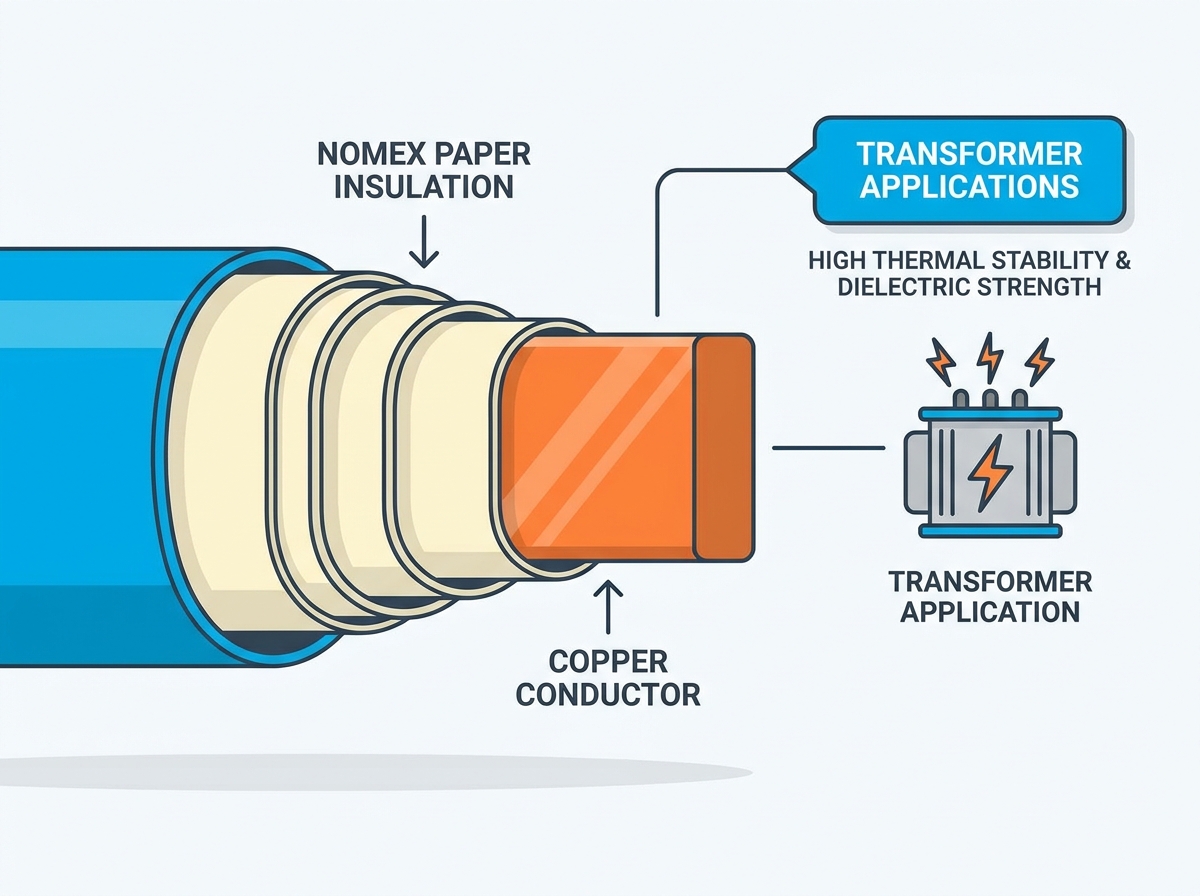
The manufacturing process involves wrapping bare copper or aluminum conductors with Nomex paper tape. High-speed taping machines apply the aramid paper under precise tension. Spiral wrapping configurations utilize specific overlap percentages to ensure complete coverage. Butt-wrapped methods align the edges perfectly, while percentage-overlapped methods provide multiple layers of continuous dielectric coverage along the entire length of the conductor. The industry-standard DuPont™ Nomex® 900 Series dominates this space. Nomex® 926 stands out as a high-density, ultra-tough paper designed specifically for demanding wire wrapping applications.
The inherent aramid polymer structure of Nomex provides a distinct molecular advantage. It offers built-in flame resistance, extreme thermal stability, and high electrical integrity. It achieves this without relying on chemical flame retardants or additives that degrade over time. The polymer chains are highly oriented, giving the paper incredible tensile strength. When comparing profiles, Nomex paper covered flat wire offers significant geometric benefits. It achieves higher space factors, optimized slot fill, and tighter winding configurations in large transformers. Round wire applications suit different flexibility requirements and specific bending radiuses.
Flat wire allows engineers to pack more conductive copper into a smaller window. The rectangular shape stacks neatly, reducing the void space between turns. This tight packing improves heat transfer from the center of the coil out to the cooling ducts. The Nomex wrapping conforms tightly to the corners of the flat wire. It does not thin out or tear at the edges like some inferior materials. This uniform insulation thickness is critical for maintaining a consistent dielectric barrier across the entire coil.
We also see variations in the number of paper layers applied. Depending on the voltage class of the equipment, manufacturers might apply anywhere from two to twelve layers of Nomex tape. Each additional layer increases the breakdown voltage but also increases the overall dimensions of the wire. Engineers must balance the need for electrical isolation with the physical space constraints of the transformer core. The high dielectric strength of Nomex allows for thinner overall insulation builds compared to Kraft paper, freeing up valuable space for more copper.
Nomex insulation boasts a continuous operating temperature rating of 220°C. It also handles short-term peak thermal overloads effectively. The material resists cold-induced embrittlement, ensuring performance and flexibility in sub-zero start-up environments. It resists shrinkage and dimensional changes at extreme temperatures. Voltage endurance, dissipation factor, and high dielectric constant remain stable throughout its lifecycle. It maintains electrical isolation and prevents partial discharge even under severe mechanical deformation.
Mechanical toughness is a critical factor during manufacturing. High tensile strength, elongation properties, and resistance to cutting prevent damage during high-tension automated winding. The elasticity of Nomex tape prevents delamination or cracking when the wire bends around tight radii. Furthermore, it performs exceptionally well against moisture ingress and humid environments. Its resistance to acid, alkali, and chemical corrosion ensures long-term stability in harsh industrial settings.
Let us look at the specific dielectric breakdown numbers. A single layer of high-density Nomex can withstand several kilovolts before failing. This high voltage endurance means that even if a transient voltage spike hits the transformer, the insulation will hold. The dissipation factor remains low even as the temperature rises. This prevents the insulation itself from generating excess heat due to dielectric losses. We test these materials under severe conditions to ensure they meet IEEE and IEC standards for Class 220 insulation systems.
The mechanical elasticity of the aramid fibers allows the paper to stretch up to 20% before breaking. When winding heavy-gauge flat wire, the outer radius of the bend stretches significantly. Kraft paper often snaps under this tension, requiring manual repair and patching. Nomex stretches and conforms, maintaining its protective barrier. This reduces manufacturing defects and speeds up the coil winding process. The tear resistance also protects the wire when it is being hammered into the stator slots of large motors.
Property Category | Nomex Paper Performance Characteristics | Operational Benefit |
|---|---|---|
Thermal Stability | Class 220°C rating, resists cold embrittlement | Prevents thermal aging and allows high overload capacity |
Dielectric Strength | High voltage endurance, low dissipation factor | Prevents partial discharge and electrical shorts |
Mechanical Toughness | High tensile strength, excellent elasticity | Resists tearing and delamination during tight winding |
Chemical Resistance | Resists moisture, acids, alkalis, and oils | Ensures longevity in harsh industrial environments |
Flame Resistance | Inherent self-extinguishing properties | Improves fire safety in dry-type applications |
Nomex tape magnet wire serves as the industry standard for dry-type Class H and Class R transformers. These units require high fire safety, self-extinguishing properties, and exceptional thermal overload capacity. For liquid-filled transformers, Nomex offers excellent compatibility with various dielectric fluids. It works seamlessly with mineral oils, silicone, synthetic esters, and chlorinated bi-phenyls. This compatibility significantly improves the power density and operational life of liquid-filled units.
Heavy-duty motors, wind turbine generators, and traction equipment rely heavily on this advanced insulation. Locomotives and transit systems operate under extreme mechanical vibration and thermal stress. Aerospace applications utilize Nomex wrapped wire where weight, space, and temperature act as critical constraints. The material provides the necessary reliability without adding unnecessary bulk to the equipment.
In wind turbine generators, the operating environment is brutal. The generators sit hundreds of feet in the air, exposed to massive temperature swings and constant vibration. The insulation must handle the thermal cycling as the wind speed varies and the generator load fluctuates. Nomex wrapped wire prevents the insulation from cracking under these dynamic loads. It also resists the moisture and salt air often found in offshore wind farm installations.
Traction motors in electric locomotives face similar challenges. They endure rapid acceleration, heavy braking, and constant physical shock from the rails. The space inside the motor housing is extremely limited. Engineers use flat wire wrapped in Nomex to maximize the copper fill factor while ensuring the insulation will not fail under the high operating temperatures. The aramid paper provides a tough physical barrier that prevents the wires from shorting out against the steel stator core.
Dry-Type Cast Resin Transformers
High-Voltage Liquid-Filled Power Transformers
Wind Turbine Generators
Railway Traction Motors
Aerospace Actuators and Generators
Industrial Crane and Hoist Motors
Comparing thermal classes reveals a stark contrast. Nomex achieves a 220°C rating, while standard Kraft paper reaches only 105°C or 120°C. The higher upfront cost of Nomex balances against its extended operational lifespan. It significantly reduces thermal aging and delivers superior overload capacity. When compared to thin enamel films, paper wrapped wire offers superior mechanical cushioning. It provides necessary physical spacing and resistance to physical damage during heavy winding processes.
Procurement teams must look beyond initial material costs. Warranty reduction, decreased maintenance intervals, and improved equipment reliability metrics strongly support its specification. Investing in higher-grade insulation ultimately protects the entire electrical apparatus from premature failure. We see facilities replacing Kraft-insulated transformers twice as often as those built with aramid insulation. The labor and downtime costs associated with a single transformer replacement far exceed the premium paid for the upgraded wire.
Enamel-coated wire works well for small motors and light-duty applications. However, in large power transformers, the enamel film is too thin to provide adequate physical separation between the heavy copper conductors. The paper wrapping acts as a physical spacer, allowing dielectric fluid to flow between the turns and carry away heat. Nomex provides this spacing while also offering a much higher thermal limit than standard paper. It will not degrade and contaminate the oil like cellulose does over time.
We also evaluate the space factor trade-offs. While Nomex is thicker than enamel, it is often thinner than the equivalent layers of Kraft paper required to achieve the same dielectric strength. This allows engineers to design smaller, lighter transformers that handle the same power rating. In mobile substations and aerospace applications, this weight reduction is a massive operational advantage. The engineering trade-off heavily favors the advanced aramid material when reliability and size are primary concerns.
Insulation Type | Thermal Class | Mechanical Durability | Moisture Resistance |
|---|---|---|---|
Standard Kraft Paper | 105°C - 120°C | Low (Brittle over time) | Poor (Absorbs water) |
Enamel Coating | 155°C - 200°C | Moderate (Prone to scraping) | Excellent |
Nomex Aramid Paper | 220°C | High (Tear resistant, elastic) | Good (Requires pre-baking) |
Impregnation and resin compatibility pose a distinct manufacturing risk. Poor penetration of varnishes through overlapping paper layers leaves voids. These voids inevitably lead to partial discharge and insulation failure. Specify correct vacuum pressure impregnation (VPI) processes to mitigate this. Always verify resin and varnish compatibility with the specific Nomex grade used in the application. The viscosity of the resin must be low enough to penetrate the tight layers of the aramid paper during the vacuum cycle.
Winding tension presents another significant challenge. Over-tensioning during manufacturing leads to conductor elongation. It causes copper deformation or insulation overlap damage. Establish strict tension control parameters on the factory floor. Utilize appropriate winding machinery calibrated specifically for aramid paper elasticity. If the tension is too loose, the paper will bunch up and create high spots. If it is too tight, the paper will stretch thin and lose its dielectric strength.
Additionally, manage moisture prior to processing. Although Nomex has low moisture absorption, trapped ambient humidity in the paper layers affects final dielectric tests. Implement proper pre-baking and storage protocols in low-humidity environments before the final VPI process. We typically bake the wound coils at 120°C for several hours to drive out any surface moisture before submerging them in the resin tank. This ensures a solid, void-free insulation system.
Handling the wire during the winding process requires care. While Nomex is tough, sharp edges on winding mandrels or tooling can cut the paper. Operators must inspect the wire path on the winding machines to ensure all guides and rollers are smooth. Any damage to the paper wrapping during manufacturing compromises the entire coil. We implement strict quality control checks, including continuous spark testing during the winding process, to catch any insulation faults immediately.
Nomex paper wrapped wire remains a strategic engineering choice for high-temperature, high-reliability electrical apparatuses. Specify Nomex if your application requires continuous operation above 150°C. Choose it if the manufacturing process involves high mechanical winding stress or demands strict fire safety compliance. The material provides unmatched thermal stability and mechanical toughness for heavy-duty applications.
Request detailed technical data sheets to verify material specifications for your project.
Consult with application engineers to design custom wire profiles and specific flat wire dimensions.
Order prototype samples to conduct thorough VPI testing and validate resin compatibility.
Review your current winding machinery tension settings to ensure compatibility with aramid elasticity.
A: Nomex paper wrapped wire features a Class 220°C continuous operating temperature rating. It handles short-term peak thermal overloads effectively and maintains structural integrity and flexibility even in sub-zero cold temperature environments.
A: Yes. It is highly compatible with a variety of dielectric fluids, including standard transformer mineral oils, silicones, synthetic esters, and chlorinated bi-phenyls, improving overall power density and lifespan.
A: Nomex offers a much higher thermal class (220°C vs 105°C/120°C). It provides superior dielectric strength, exceptional mechanical durability, and greater resistance to thermal aging compared to standard cellulose Kraft paper.
A: Nomex is compatible with a wide range of impregnation materials. This includes most commercial varnishes, epoxy resins, silicone fluids, synthetic esters, and standard mineral oils used in VPI processes.
A: Nomex has inherently low moisture absorption compared to standard cellulose. However, trapped ambient humidity between paper layers can affect dielectric tests, making pre-baking necessary before the final impregnation process.
A: The Nomex 900 series, particularly Nomex 926, provides an optimal balance of high dielectric strength, extreme tear resistance, and chemical stability, making it specifically suited for the mechanical stresses of wire wrapping.