Views: 0 Author: Site Editor Publish Time: 2026-10-20 Origin: Site
Reactor windings operate under continuous mechanical stress, high thermal loads, and strict spatial constraints. These critical components rely entirely on their internal insulation to survive decades of continuous operation. Selecting the correct insulation material directly impacts the unit’s lifecycle, physical footprint, and failure rate. Procurement and design teams frequently face a difficult choice. They must balance the proven reliability of traditional kraft paper against the space-saving advantages of advanced polymer films. This single decision often dictates core dimensions and the entire cooling system design.
Our guide provides an evidence-based framework for evaluating these insulation types. We explore thermal class requirements, dielectric performance, and long-term economic impacts in reactor applications. You will learn how to properly align winding specifications with your operational demands, ensuring optimal efficiency and durability.
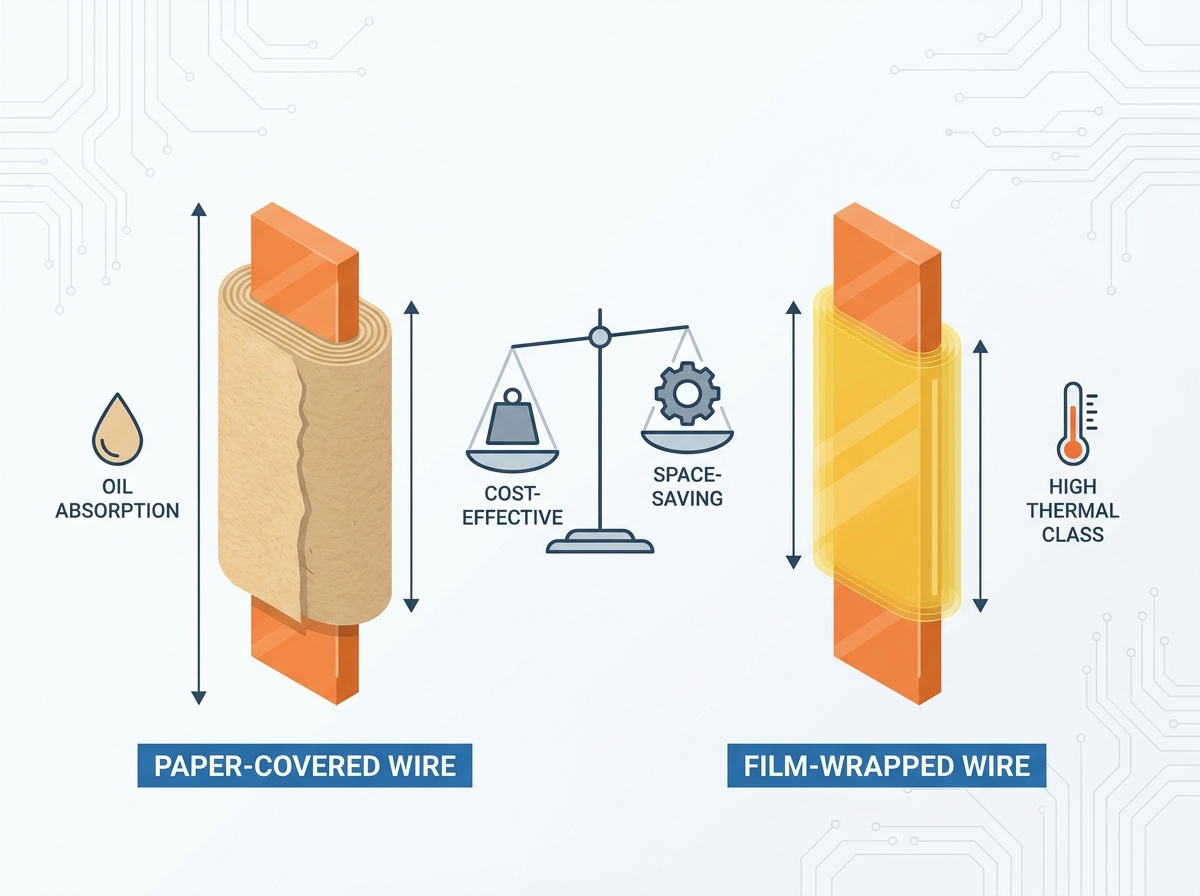
Traditional paper insulation remains the industry standard for oil-immersed applications due to its superior oil absorption and cost-efficiency, but limits miniaturization.
Polyimide and PET film-wrapped options offer significantly higher thermal ratings and dielectric strength, enabling a higher copper fill factor in dry-type or space-constrained reactors.
The choice ultimately hinges on the specific cooling medium (dry vs. oil), the required thermal class, and the trade-off between upfront material costs and long-term operational footprint.
Heat generation dictates every aspect of reactor design. You must define the required thermal class based on the expected duty cycle. Standard oil-immersed reactors often use Class A insulation, rated for 105°C. These units handle moderate, predictable loads efficiently. Dry-type reactors face harsher conditions. They require Class F (155°C) or Class H (200°C+) materials to survive. Insulation materials degrade rapidly when pushed beyond their thermal limits. A mere 10°C increase above the rated temperature can halve the lifespan of standard materials. Engineers must carefully calculate peak overload temperatures to prevent premature thermal breakdown.
Reactors frequently encounter severe voltage transients. Insulation must handle localized electrical stress without failing. Corona discharge poses a constant threat in high-voltage environments. It slowly degrades the insulation structure over time. You must evaluate how different materials resist partial discharge. Excellent dielectric strength prevents catastrophic short circuits. It acts as a reliable barrier between adjacent conductor turns. Design teams rely on impulse testing standards to verify this capability. Peak dielectric efficiency allows engineers to safely reduce the distance between winding layers.
Winding processes apply immense physical stress to conductors. The insulation material must withstand significant elongation during production. Bending radius constraints challenge even the most robust coverings. Tight corners on rectangular coils often cause brittle materials to tear. Winding machinery applies high tension to keep coils compact. If the insulation shears or separates, bare copper becomes exposed. This exposure guarantees a short circuit. High mechanical integrity ensures uniform coverage across every inch of the wire. Manufacturers must balance flexibility against cut-through resistance to achieve optimal results.
The space factor fundamentally alters reactor design. This metric measures the ratio of active conductor volume to the total winding window area. Thicker insulation pushes copper lines further apart. It forces the overall reactor core to grow larger. A bulky core requires more electrical steel, driving up weight. Thinner insulation sharply increases the copper fill factor. You can pack more conductive material into a restricted space. High space factors enable highly compact designs. They reduce the required volume of steel and lower overall manufacturing expenses.
Suppliers construct paper covered flat winding wire using heavily refined cellulose products. Typical variations include standard Kraft paper, highly flexible crepe paper, or thermally upgraded paper. Wrapping machines apply these tapes tightly over a bare flat copper conductor. The overlapping layers provide excellent physical padding. Cellulose fibers offer exceptional tensile strength. They resist the heavy compressive forces found inside large transformer tanks. These robust physical properties make paper a highly dependable choice for traditional, heavy-duty applications.
Paper truly excels inside liquid-filled tanks. Its porous fibrous structure acts like a sponge. It absorbs transformer oil rapidly during the vacuum impregnation process. This saturation eliminates dangerous air pockets within the winding matrix. Air possesses low dielectric strength, whereas oil boasts high resistance. Combining oil and paper creates a unified, highly effective dielectric barrier. It also forms an exceptional cooling medium. The oil flows continuously through the fibers, actively wicking heat away from the hot copper core. This synergistic relationship maximizes operational efficiency.
The global supply chain heavily favors cellulose insulation. It remains universally available and highly standardized. Production methods have matured over nearly a century. This maturity drives down upfront material costs significantly. Sourcing bulk quantities rarely presents logistical challenges. Factories can accurately predict pricing trends. They leverage these lower raw material costs to bid competitively on large-scale infrastructure projects. When project budgets constrain initial capital expenditure, paper provides an incredibly compelling economic advantage.
Despite its rich history, paper has strict operational boundaries. Thicker radial insulation immediately reduces the copper fill factor. You cannot build ultra-compact reactors using thick paper layers. Additionally, standard cellulose has a low inherent thermal classification. It deteriorates rapidly in dry, high-heat environments. Moisture poses another critical vulnerability. Unimpregnated paper absorbs atmospheric humidity aggressively. Manufacturing facilities must utilize energy-intensive vacuum drying ovens before introducing oil. This extra processing step adds significant time to production schedules.
Modern engineering relies heavily on film wrapped copper flat wire for advanced applications. Manufacturers utilize high-performance polymers to create these barriers. Polyimide (often recognized by the Kapton brand) and PET films dominate this category. Precision wrapping machines apply these ultra-thin films uniformly. High-grade adhesives often bond the overlapping layers together. This bonding creates a seamless protective jacket. It completely shields the conductor from environmental contaminants. The resulting wire boasts an exceptionally smooth surface finish.
Polymer films redefine spatial efficiency. They offer an exceptionally thin insulation profile. A standard polyimide wrap requires only a fraction of a millimeter. This thinness allows for much tighter winding. The distance between copper turns shrinks dramatically. You can achieve massive reductions in overall reactor dimensions. A smaller coil requires a correspondingly smaller iron core. Less steel immediately translates to a much lighter unit. Transportation costs plummet, and installation becomes significantly easier in crowded substations.
High temperatures destroy lesser materials, but films thrive under thermal duress. Polyimide maintains absolute structural and dielectric integrity at extreme heat. Some advanced films operate continuously at 220°C (Class R). They shrug off severe overload conditions effortlessly. This stability prevents the insulation from turning brittle or flaking away. Engineers specify these films for high-frequency designs where skin-effect heating poses a severe threat. You gain an immense safety margin against unexpected thermal spikes.
Advanced polymers carry a substantial price premium. The higher initial cost per kilogram deters some budget-conscious buyers. Furthermore, specialized handling becomes mandatory on the factory floor. Hard machinery edges can easily scratch the ultra-thin film. A deep scratch compromises the entire dielectric barrier. Finally, film lacks the oil-wicking properties of paper. While perfectly compatible with certain mineral and ester oils, it alters the fundamental cooling dynamic. Heat must conduct through the solid polymer rather than transfer via saturated oil flow.
Table 1: Dielectric & Thermal Efficiency Comparison Matrix
Feature | Paper Covered Flat Wire | Film Wrapped Flat Wire |
|---|---|---|
Insulation Thickness | Thick (Reduces Fill Factor) | Ultra-thin (Maximizes Fill Factor) |
Dielectric Strength | High (Only when oil-impregnated) | Exceptionally High (Inherent) |
Thermal Class | Class A (105°C) typically | Class H (200°C) up to Class R (220°C) |
Moisture Resistance | Very Low (Highly hygroscopic) | Excellent (Impervious to humidity) |
Evaluating film wrapped vs paper insulated wire requires analyzing breakdown voltage precisely. Film offers an immensely higher baseline dielectric strength. It provides robust protection in a microscopically thin profile. You gain maximum voltage resistance per millimeter of thickness. Conversely, paper relies entirely on oil saturation to achieve its peak dielectric performance. Dry paper fails at surprisingly low voltages. Once saturated, however, the oil-paper composite becomes formidable. Yet, film still wins outright in environments lacking liquid dielectrics.
Paper easily wins on raw material pricing. The initial capital expenditure for cellulose remains remarkably low. However, looking only at raw wire prices obscures the bigger economic picture. Film allows you to reduce the required volume of both copper and steel. A smaller core design requires less raw metal. It demands a smaller steel tank and less cooling oil. Lower transportation weights further reduce project expenses. Therefore, while film costs more upfront, it can significantly lower the overall unit cost of the finished reactor.
Moisture represents the ultimate enemy of winding insulation. Paper displays high vulnerability to moisture ingress. Before oil impregnation, a humid factory floor can ruin cellulose. It absorbs water vapor aggressively, degrading its insulation resistance. Film exhibits incredibly robust moisture resistance. It repels atmospheric humidity entirely. Additionally, films resist harsh chemical attacks from contaminated oils or aggressive varnishes. Paper can degrade chemically over decades, forming sludge and organic acids. Films maintain their chemical neutrality throughout their operational lifespan.
Selecting the right wire dictates reactor success. We recommend clear deployment strategies based on proven use cases.
Default to Paper: Choose cellulose for large-scale, oil-immersed shunt reactors. In sprawling utility yards, physical space is rarely the primary constraint. The unbeatable cost-efficiency and superior oil circulation make paper the logical choice.
Default to Film: Select polymers for dry-type reactors or high-frequency applications. Compact traction transformers on locomotives demand maximum thermal density. Film thrives anywhere space is tight and ambient heat is extreme.
Factory equipment must adapt to the chosen insulation material. Winding machines exert tremendous pulling force. If operators calibrate this machinery improperly, film can stretch thin or shear entirely. Stretching reduces the film's thickness, compromising the dielectric barrier. Paper poses different challenges. It generally resists stretching but tears easily. If edge-bending radii on a rectangular mandrel are too aggressive, paper snaps. Engineers must define exact corner radii specifications. Machine operators require targeted training for each material.
Proper wrapping geometry prevents electrical faults. You must source wire with highly consistent overlapping. Typical standards require a 50% or 66% overlap pitch. This layering ensures continuous protection. During intense thermal expansion, coils shift and flex. Poor adhesion between film layers allows them to slide apart. This sliding exposes bare copper. High-quality film wires utilize thermoplastic adhesives. Operators bake the finished coil, melting the adhesive. This process fuses the overlapping layers into an impenetrable solid jacket.
Dry-type reactors undergo complex encapsulation processes. Manufacturers often dip the entire wound coil into specialized varnishes. You must ensure absolute chemical compatibility. The chosen film adhesive must never react negatively with these resins. A mismatched chemical interaction can dissolve the film's adhesive over a 20-year lifespan. Similarly, paper must remain compatible with modern synthetic ester oils. Rigorous accelerated aging tests verify these combinations. Always confirm compatibility before approving full-scale production runs.
Purchasing teams must look beyond raw material pricing. You should evaluate wire manufacturers based on strict testing transparency. Reliable suppliers provide comprehensive documentation. They offer continuous pinhole testing data and detailed dielectric breakdown reports. Follow these critical steps when evaluating a new supplier:
Request lot-specific certifications for tensile strength and elongation.
Review historical data on breakdown voltage variations per batch.
Audit the supplier's dust-control protocols, especially for film wrapping.
Verify their ISO compliance regarding raw material traceability.
Prioritizing transparency guarantees fewer failures on your winding floor.
Choosing between these insulation materials fundamentally shapes your reactor design. Align your choice directly with the reactor's designated cooling method and strict spatial constraints. Heavy, oil-filled units benefit from paper's unmatched absorption and cost profile. Compact, hot-running dry units demand the extreme resilience of polymer films. There is no universal winner, only the optimal match for your specific engineering parameters.
Move forward systematically to avoid costly mistakes. We recommend requesting short sample lengths from your shortlisted suppliers. Conduct rigorous mechanical winding trials on your factory floor to test corner radiuses and tension limits. Review independent, third-party thermal aging data. Compare the lifecycle costs, factoring in reduced steel and copper volumes. Complete these critical evaluations before committing to any bulk, factory-direct wire orders.
A: Yes, it is generally safe. Polyimide and PET films remain chemically stable in standard mineral and ester oils. However, unlike paper, polymer films do not absorb oil. This fundamentally alters the localized dielectric dynamic and cooling efficiency. Heat must conduct through the solid film layer. Engineers must adjust thermal modeling to account for this lack of oil wicking.
A: Paper insulation is significantly thicker. A typical radial thickness for standard paper ranges from 0.15mm to 0.50mm, depending on the required layers. Polyimide film wraps achieve equivalent or superior dielectric protection with a radial thickness of just 0.04mm to 0.07mm. This drastic reduction saves massive amounts of core space.
A: Paper-covered wire generally requires larger, gentler corner radii. Sharp bends frequently cause cellulose fibers to snap or tear apart. Film-wrapped wire handles tighter cornering efficiently due to polymer elasticity. However, extreme sharp edges on the bare copper itself can puncture the film. Manufacturers must carefully round the copper edges before wrapping.