Views: 0 Author: Site Editor Publish Time: 2026-10-25 Origin: Site
Electrical reactors operate under continuous high thermal stress, mechanical vibration, and high-voltage conditions. In these punishing environments, insulation failure is simply not an option. A single compromised layer can lead to catastrophic system faults, operational downtime, and severe safety hazards.
Traditional enamels often crack or fail under the rigorous physical demands of large-scale reactor winding. This vulnerability drives a critical industry transition toward advanced composite wraps. These layered materials offer superior mechanical toughness while maintaining exceptional dielectric properties.
We provide technical buyers and engineering managers an evidence-based framework for evaluating these advanced materials. You will learn how to rigorously test and qualify wire solutions. This guide helps you mitigate manufacturing risks, prevent premature degradation, and ensure long-term operational reliability in your high-voltage applications.
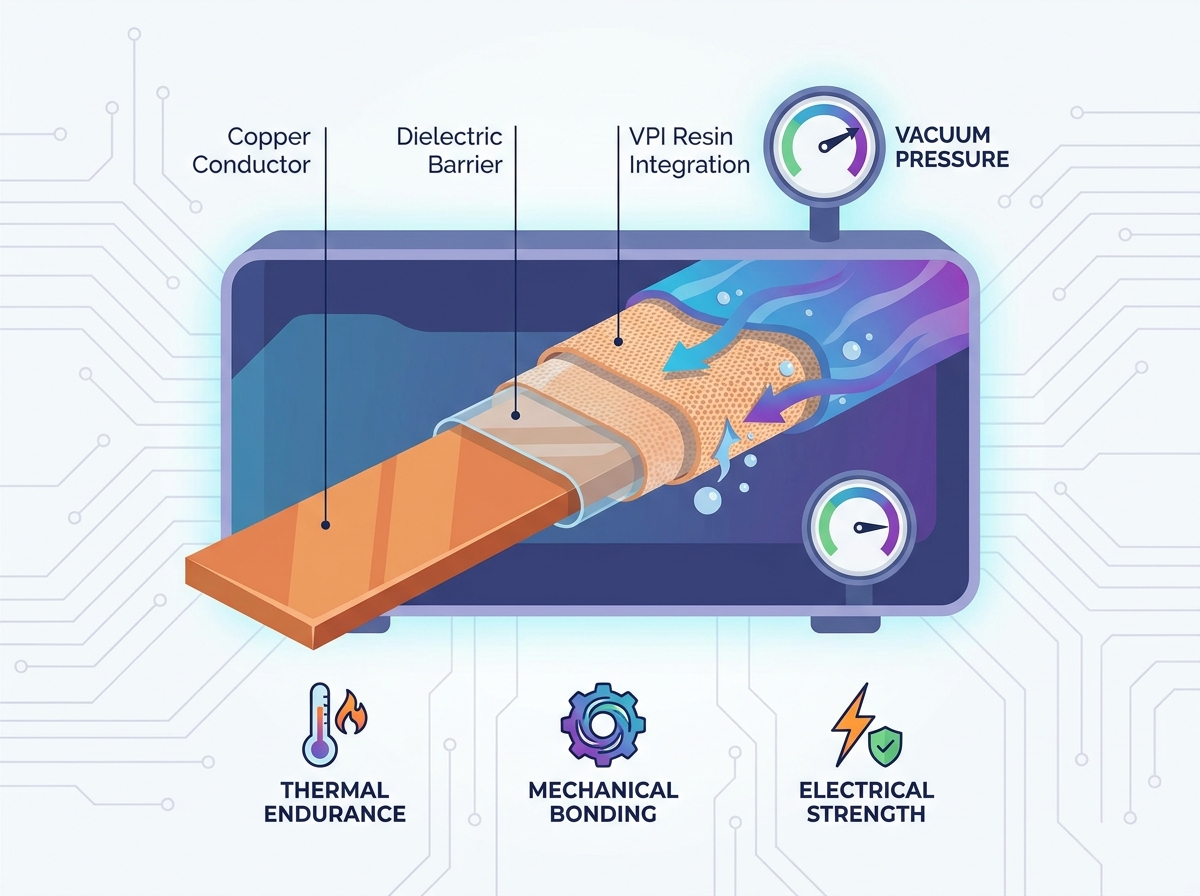
Resin Compatibility is Critical: The nonwoven layer must act as a porous matrix for VPI (Vacuum Pressure Impregnation) resins while the inner film provides the primary dielectric barrier.
Thermal Degradation Matters: Qualification requires empirical data on how polymer films behave under continuous thermal cycling, not just peak temperature ratings.
Mechanical Integrity Prevents Delamination: Tight-radius winding of flat wire demands strict evaluation of the fabric-to-metal bonding process.
Vendor Transparency is Required: A qualified supplier must provide comprehensive audit trails, thermal modeling data, and strict dimensional tolerances.
Reactor coils face immense operational demands. They must continuously manage electrical stress while enduring extreme physical and thermal conditions. Engineers must carefully evaluate every material component to ensure uninterrupted performance over decades of use. You cannot rely on baseline materials when dealing with high-voltage magnetic fields.
We must define clear success criteria for reactor coils before qualifying any insulation material. Successful coil designs must effectively manage partial discharge events. They must resist immense short-circuit mechanical forces. Furthermore, they must endure high operating temperatures without structural degradation.
Partial Discharge Management: The insulation must prevent micro-voids where localized corona discharges occur.
Mechanical Resistance: The wrapped material must withstand extreme shear and compressive forces during sudden short-circuit events.
Thermal Endurance: The coil needs efficient heat dissipation pathways to prevent localized hot spots.
When engineering these systems, non woven film wrapped flat wire emerges as the optimal solution. It perfectly balances a high space factor (fill factor) with robust mechanical protection during coil winding. Flat wire inherently packs more tightly than round wire. This geometry reduces void spaces and maximizes copper density within the core.
Engineers constantly face a critical design trade-off. You must balance insulation thickness against cooling efficiency and footprint. Thicker insulation provides a higher dielectric safety margin. However, it impedes heat transfer and increases the overall size of the reactor. The combination of a thin, high-dielectric polymer film and a protective non-woven overwrap solves this problem. It delivers maximum dielectric strength without unnecessarily expanding the coil dimensions.
Wire insulation fails over time, not overnight. To ensure reliability, we must rigorously assess thermal degradation phenomena in polymer films. Many suppliers present short-term heat shock tests as proof of thermal durability. This approach is dangerously misleading for continuous-duty reactors. Instead, evaluate suppliers strictly based on their long-term Relative Thermal Index (RTI) data. A polymer film might survive 240°C for a few hours, but it could rapidly embrittle at 180°C over 20,000 hours. You need empirical aging curves to predict true lifecycle performance.
Beyond thermal endurance, bonding integrity determines mechanical survival. You must thoroughly review the vendor's bonding process analytics. The adhesion between the inner copper substrate, the intermediate film layer, and the outer non-woven fabric must resist intense shear forces. During tight winding, layers experience differential stretching. Poor adhesion causes the protective fabric to slip or the inner film to delaminate. Ask your supplier for detailed peel-strength data and thermal-mechanical modeling results.
Material benchmarking provides a clear perspective on your options. You should actively compare standard baseline materials against advanced composites based on your reactor's specific thermal class rating.
Material Type | Thermal Class | Mechanical Flexibility | Typical Application |
|---|---|---|---|
Standard Polyester Blend | Class F (155°C) | Moderate | Low-stress distribution reactors |
Polyimide (PI) Composite | Class H to C (180°C - 220°C) | High | High-load, continuous duty reactors |
Aramid-Blended Wraps | Class H (180°C) | Exceptional | Systems facing extreme short-circuit forces |
For standard applications, engineers frequently utilize polyester film wrapped copper wire. It offers reliable performance for moderate thermal classes. However, if your reactor operates under extreme loads or requires a Class H rating, you must transition to higher-grade polyimide or aramid-blended alternatives.
Modern reactor manufacturing relies heavily on the Vacuum Pressure Impregnation (VPI) process. The insulation system must actively facilitate this process. The primary function of the outer wrap is to capture and hold the resin.
We call this the porosity requirement. A high-quality nonwoven insulation winding conductor must demonstrate optimal porosity. Assess exactly how efficiently the non-woven layer absorbs and retains impregnating resins. If the fabric is too dense, the resin cannot penetrate. If the chemistry is incompatible, the resin might cause the underlying film to swell, wrinkle, or detach. You need an optimal matrix that wicks the resin deeply into the coil structure without compromising the film barrier.
Dielectric breakdown voltage serves as your primary safety metric. You must establish baseline acceptable metrics for this voltage across two distinct phases: pre-impregnation and post-impregnation.
Pre-Impregnation Testing: Measures the raw dielectric strength of the dry film and fabric wrap. It verifies the tape overlap consistency.
Post-Impregnation Testing: Evaluates the monolithic strength of the fully cured composite system. It confirms resin compatibility and void elimination.
Thermal Cycle Dielectric Testing: Simulates years of operation to ensure the breakdown voltage remains stable after repeated heating and cooling.
Finally, mandate rigorous testing data for the Partial Discharge Inception Voltage (PDIV). High-voltage reactors create intense electrical fields. Poorly wrapped wire inherently contains microscopic air voids between the overlap layers. These voids ionize under high voltage, leading to premature corona degradation. A high PDIV indicates a tightly wrapped, perfectly impregnated coil free of internal air pockets.
Laboratory data only tells part of the story. Real-world winding processes introduce severe physical stresses that expose hidden manufacturing defects. Engineering teams must anticipate these risks before they initiate full-scale production.
Corner cracking on flat wire represents the most critical mechanical risk. When bending flat copper wire around tight-radius mandrels, the insulation stretches aggressively on the outer edge. It simultaneously compresses on the inner edge. We often see insulation tearing or dangerous thinning specifically on the corners. You must verify that the vendor uses a properly radiused bare copper profile and highly flexible film wraps to prevent this corner failure.
Overlap tolerances dictate the consistency of your dielectric barrier. Most composite tapes use either a 50% or 66% overlap during the wrapping phase. You must evaluate the precision of this process. Inconsistent tension leads to localized thick spots and bare spots. Thick spots impede vital heat dissipation and disrupt the precise stacking of the coil. Bare spots cause immediate dielectric failure during high-voltage operation.
Best Practice: Implement continuous inline laser micrometer measurement during the wrapping process to detect overlap variations instantly.
Common Mistake: Ignoring tape tension drift on the wrapping machine, which slowly degrades overlap consistency over long wire runs.
Best Practice: Perform automated spark testing at the exact nominal test voltage required by the standard, not a generic default voltage.
Moisture absorption presents another significant implementation hurdle. We must acknowledge the highly hygroscopic nature of some non-woven materials. They pull humidity directly from the factory air. If you introduce moisture-laden wire into a VPI tank, the water vaporizes under vacuum. This creates severe foaming and leaves massive voids in the cured resin matrix. Require strict protocols for climate-controlled wire storage. Mandate mandatory pre-baking procedures to drive out all trapped moisture prior to the VPI process.
Selecting the right wire supplier requires a rigid, evidence-based qualification process. Do not accept marketing claims in place of engineering data. You must evaluate suppliers based on their transparency, technical capabilities, and adherence to global standards.
First, mandate access to batch-specific test reports. General product datasheets are insufficient for high-voltage reactor applications. You need empirical data from the exact batch of wire you intend to purchase. Require detailed elongation tests to prove copper softness. Demand adherence flexibility results to ensure the film survives bending. Request dielectric strength data captured under simulated thermal loads, not just at room temperature.
Verify strict adherence to applicable industry standards. Global frameworks like the IEC 60317 series define precise testing methodologies for wrapped conductors. In North America, NEMA MW 1000 provides exhaustive performance criteria. A qualified vendor will eagerly provide certification documents proving their materials meet or exceed these specific parameters.
Prototyping serves as your final risk mitigation step before full procurement. Define the success criteria for a pilot sample run. Evaluate spooling consistency; the wire must unspool smoothly without twisting or snagging. Mandate a strict "no splicing" policy within continuous lengths. Finally, assess the wire's performance in a pilot winding phase. Wind a test coil, impregnate it, and section it to verify resin penetration and corner integrity.
Evaluation Phase | Key Metric | Acceptance Criteria |
|---|---|---|
Documentation | Batch-Specific Testing | Full trace reports for elongation and peel strength. |
Compliance | Industry Standards | Certified to IEC 60317 and NEMA MW 1000. |
Prototyping | Spooling Consistency | Zero snags, zero inline splices per required length. |
Validation | Pilot Winding Results | No corner cracking; 100% successful resin penetration. |
Qualifying the right insulation is a complex engineering balancing act. You must carefully weigh dielectric strength against mechanical toughness and long-term thermal endurance. Standard enamels simply cannot survive the modern demands of large-scale electrical reactors. Advanced composite wraps provide the necessary durability, provided you evaluate them rigorously.
Risk mitigation must remain your primary focus during procurement. Choosing a supplier based purely on the lowest cost-per-kg ignores the severe realities of the power industry. The exponential cost of a reactor field failure due to insulation delamination far outweighs any initial material savings. Equipment downtime, replacement logistics, and reputational damage cost magnitudes more than premium wire.
We encourage procurement teams to take immediate action. Request comprehensive technical specifications and long-term thermal degradation curves from your shortlisted vendors. Demand sample materials for internal validation testing. By implementing a strict, data-driven qualification framework, you guarantee the long-term reliability and safety of your high-voltage reactor systems.
A: It acts as a wicking medium, drawing the resin deep into the coil matrix. Once cured, it creates a solid, void-free monolithic structure that improves both mechanical rigidity and thermal conductivity.
A: Prolonged exposure to operating temperatures exceeding the polymer's thermal index, often exacerbated by chemical incompatibility with the chosen impregnating resin or localized hot spots due to poor heat dissipation.
A: Flat wire significantly improves the space factor (packing density) of the coil, allowing for a more compact reactor design with better heat dissipation profiles compared to equivalent round wire configurations.