Views: 0 Author: Site Editor Publish Time: 2026-10-30 Origin: Site
Modern reactor design forces engineers to constantly balance conflicting demands. They must minimize raw material expenses while maximizing space factor and overall electrical efficiency. Both copper and aluminum substrates serve as highly viable options for dry-type and oil-immersed reactors. However, these metals require fundamentally different structural and thermal design concessions. Failing to account for these inherent differences often leads to premature equipment failures or bloated installation footprints.
This article provides an objective, engineering-focused comparison between these two critical materials. We will explore how different physical properties dictate specific manufacturing and operational adjustments. You will learn how to evaluate specific thermal, mechanical, and electrical constraints for your projects. Ultimately, we aim to help your procurement and design teams make evidence-based specification decisions.
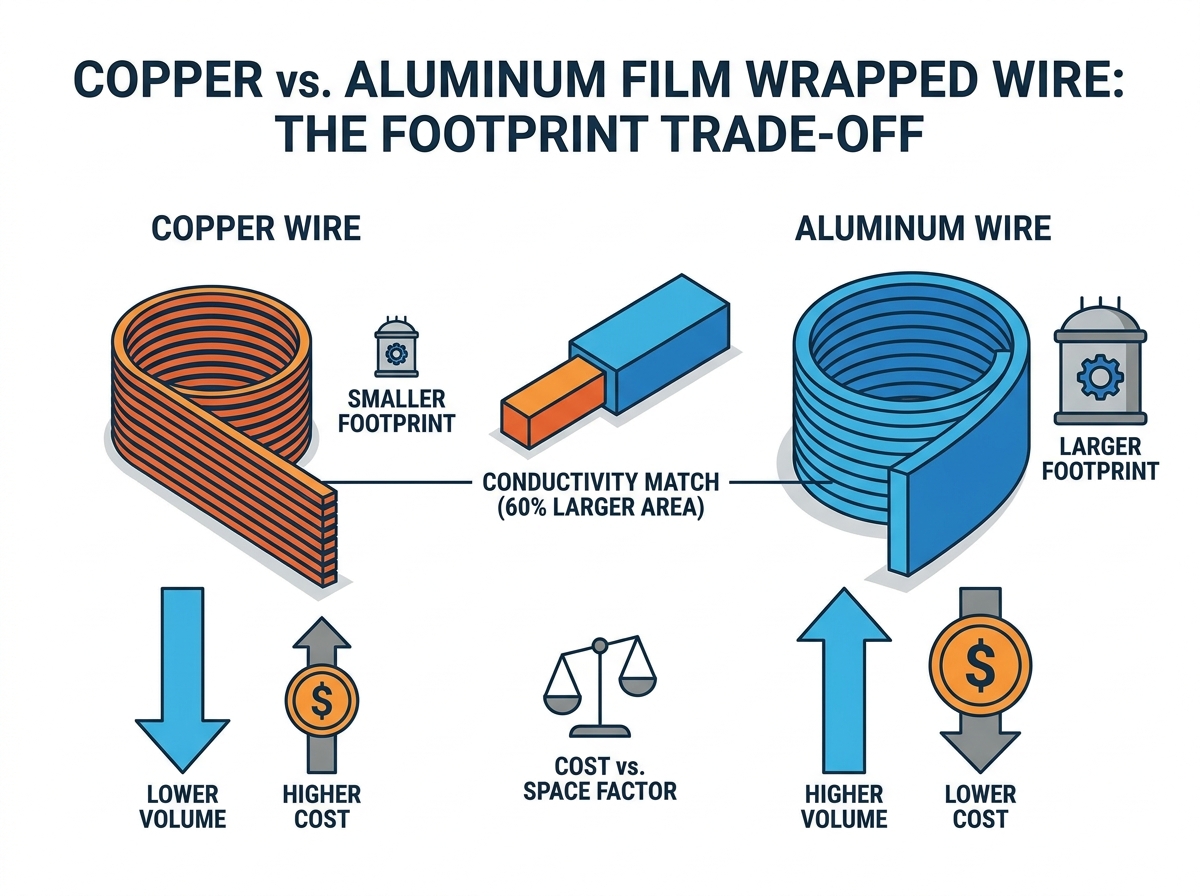
Cost vs. Volume: Aluminum significantly reduces material costs and overall reactor weight but requires up to a 60% larger cross-sectional area to match copper's conductivity, increasing the reactor's physical footprint.
Mechanical Integrity: Copper offers superior tensile strength, making it naturally more resistant to short-circuit mechanical forces without requiring oversized structural supports.
Insulation Synergy: Both metals perform exceptionally well with nonwoven film insulation (e.g., Dacron, Nomex), which ensures high resin absorption during VPI (Vacuum Pressure Impregnation) for excellent dielectric and mechanical stability.
Termination Realities: Choosing aluminum necessitates strict termination protocols (e.g., bimetallic lugs, oxide-inhibiting compounds) to prevent galvanic corrosion and thermal creep.
Before comparing substrate metals, we must understand the physical format of the conductor itself. Engineers primarily specify flat, rectangular wire for industrial reactors rather than traditional round wire. Rectangular conductors drastically improve the overall space factor within a coil window. By stacking flat conductors tightly together, manufacturers eliminate the empty voids inevitably created by round wire geometries.
Beyond spatial efficiency, flat configurations provide superior heat dissipation. They offer a larger surface area relative to their cross-section, allowing cooling air or insulating oil to extract heat faster. Furthermore, rectangular profiles help mitigate the skin effect in high-current applications. High-frequency AC currents naturally push toward the conductor's outer surface. A flat shape distributes this current more evenly, reducing localized heating and lowering overall AC resistance.
The insulation system surrounding these conductors plays an equally critical role. Selecting a high-quality nonwoven film wrapped winding wire provides three distinct advantages. First, it dictates the thermal class rating of the reactor, determining the maximum safe operating temperature. Second, it prevents catastrophic turn-to-turn electrical shorts under high voltage stress. Finally, nonwoven materials like Dacron or Nomex offer exceptional resin permeability. During the manufacturing phase, varnishes easily penetrate the nonwoven layers. This process bonds the separate turns into a single, highly stable unit.
When selecting a winding material, design teams should base their decisions on three primary pillars:
Upfront Capital Expenditure: Raw material costs fluctuate heavily. Procurement teams must weigh the immediate commodity price of the metal against the cost of the surrounding structural components.
Physical Footprint Constraints: Offshore platforms, underground vaults, and retrofitted switchgear rooms often impose strict dimensional limits. You must consider the maximum allowable volume for the finished reactor.
Operating Environment: Severe load profiles and environments heavy in harmonic distortion generate excess heat. Teams must evaluate how well the chosen metal handles continuous thermal stress and localized hot spots.
Electrical conductivity dictates the fundamental geometry of any reactor coil. Copper stands as the historical industry benchmark. Standard Electrolytic Tough Pitch (ETP) copper delivers 100% IACS (International Annealed Copper Standard) conductivity. Conversely, electrical-grade aluminum alloys, such as 1350 or 1060, offer approximately 61% to 62% IACS conductivity. To achieve an equivalent electrical resistance, engineers must increase the cross-sectional area of an aluminum conductor by roughly 60% to 64%. This single geometric reality drives almost every subsequent design compromise.
Thermal dynamics also differ significantly between the two metals. You must account for the coefficient of thermal expansion (CTE) during the engineering phase. Aluminum expands approximately 30% more than copper under identical temperature increases. If engineers fail to accommodate this expansion, the resulting mechanical stress can fracture the insulation or damage the core constraints. Evaluating copper vs aluminum film wrapped wire behavior under continuous thermal cycling is essential. Continuous overloading causes repeated expansion and contraction. Copper tends to maintain its dimensional stability better over decades of extreme load variations.
High-frequency environments introduce another layer of complexity. Line and shunt reactors frequently encounter significant harmonic currents. These harmonics induce eddy currents and stray losses within the conductors. Because an equivalent-capacity aluminum coil requires a larger physical surface area, it exposes more metal to these stray magnetic fields. Consequently, aluminum designs can suffer from slightly higher high-frequency harmonic losses unless designers utilize thinner, multi-stranded flat wire configurations to compensate.
Physical and Electrical Property Comparison
Property | Copper (ETP) | Aluminum (1350/1060) | Design Impact |
|---|---|---|---|
Conductivity (IACS) | 100% | ~61% | Aluminum requires a 60%+ larger cross-section for equal resistance. |
Specific Gravity | 8.89 | 2.70 | Aluminum reduces conductor weight by roughly 50%. |
Coefficient of Thermal Expansion | 16.6 µm/(m·K) | 23.0 µm/(m·K) | Aluminum requires more robust expansion allowances. |
Tensile Strength (Annealed) | ~220 MPa | ~60-80 MPa | Copper withstands short-circuit forces inherently better. |
Electrical faults generate massive electromagnetic forces within seconds. During a short-circuit event, coils experience extreme radial and axial mechanical stress. Copper possesses a significantly higher yield strength compared to standard aluminum alloys. This inherent rigidity allows copper windings to withstand severe electromagnetic shocks without permanent deformation. For applications near major grid substations or heavy industrial machinery, this natural resilience provides an immediate engineering advantage.
Designing reliable equipment using aluminum simply requires different methodologies. Because aluminum possesses lower tensile strength, engineering teams must compensate through external structural reinforcements. Manufacturers utilize tighter winding tension during production. They also implement enhanced clamping structures, heavy-duty pressure plates, and reinforced fiberglass ties. Furthermore, designers often specify thicker or highly optimized nonwoven film layers. These specialized layers provide added structural rigidity once the curing process finishes.
The Vacuum Pressure Impregnation (VPI) process heavily influences the final mechanical durability of both metals. Bare wire alone cannot survive long-term industrial vibration. However, the nonwoven film on the substrates absorbs specialized epoxy or polyester varnish during VPI. Once baked and cured, this resin-saturated film transforms individual loose turns into a monolithic, mechanically rigid coil block. This chemical and mechanical synergy effectively mitigates much of aluminum's inherent softness. A properly impregnated aluminum coil easily meets international short-circuit testing standards, provided the initial clamping design is robust.
The most compelling argument for aluminum lies in its distinct weight advantage. Aluminum has a specific gravity approximately 30% that of copper. Even after accounting for the larger required cross-section, a coil utilizing film wrapped aluminum flat wire generally weighs up to 50% less than an equivalent copper coil. This massive weight reduction directly lowers shipping costs and simplifies logistics. It also reduces the need for heavy-duty structural enclosures, crane reinforcements, and specialized concrete mounting pads.
However, you trade weight reduction for a larger physical envelope. The 60% increase in conductor volume impacts every surrounding component. A thicker aluminum coil requires a correspondingly larger core window to house the windings. To maintain the correct magnetic flux density, manufacturers must use larger laminations of electrical core steel. The overall outer dimensions of the reactor enclosure inevitably expand. In highly constrained environments, this space factor penalty can completely disqualify aluminum.
The final cost equation involves balancing these competing factors. Aluminum commodity prices remain historically lower and far more stable than volatile copper markets. This predictability helps procurement teams lock in project budgets safely. Yet, the cost savings realized on the bare wire must offset the added expenses. You will pay more for the extra core steel, larger steel enclosures, and increased volume of impregnation varnish. For high-capacity reactors, the raw material savings usually dominate, making aluminum highly economical. For smaller or heavily constrained units, the extra structural costs can negate the aluminum advantage.
Improper termination represents the single highest risk factor when deploying aluminum conductors. Aluminum immediately forms a thin, highly resistive oxide layer when exposed to air. Furthermore, it suffers from "cold flow" or thermal creep. Under continuous pressure from a standard mechanical lug, aluminum slowly deforms and loosens over time. This loosening increases electrical resistance, generating localized heat that eventually melts the connection. To prevent this, technicians must employ strict mitigation strategies. We strongly recommend cold welding, specialized compression crimps, and bimetallic transition lugs. Installers must also apply oxide-inhibiting joint compounds generously.
Manufacturing facility capabilities also dictate material choice. Winding flat aluminum requires highly calibrated tensioning equipment. Because the metal is softer, excessive tension can stretch the conductor. This elongation reduces the cross-sectional area and damages the nonwoven film insulation. Manufacturers must ensure their tooling can handle delicate tension limits without compromising the tight packing density required for a solid coil.
To streamline the decision process, consider the following shortlisting scenarios for your next specification:
Choose Copper when: Installation space is strictly limited. Typical scenarios include offshore oil platforms, underground transit systems, or retrofitting older switchgear cabinets. You should also select copper if efficiency constraints are exceptionally severe, or if the reactor will face extreme, repetitive short-circuit force risks.
Choose Aluminum when: Upfront capital expenditure is the primary project driver. Aluminum also excels when severe weight restrictions exist, such as in pole-mounted applications, rooftop installations, or mobile substations. If the physical footprint is mostly unrestricted, aluminum remains the superior economic choice.
Evaluating reactor winding materials requires a balanced perspective. Neither metal is objectively superior across all metrics. Copper delivers unmatched spatial efficiency and inherent mechanical strength. Aluminum provides extraordinary weight reduction and robust budget stability. The optimal choice depends entirely on your specific application's footprint constraints, thermal environment, and upfront capital budget.
We advise engineering teams to move beyond basic assumptions. Run parallel CAD and thermal simulations for both materials. Ensure you apply the specific nonwoven film insulation class required by your operating environment. Simulating both options highlights exactly where spatial conflicts or thermal hotspots will occur before manufacturing begins.
Take the guesswork out of your next high-voltage project. Contact our sales engineering team today for a comprehensive material consultation. We can help you navigate footprint limitations, analyze harmonic heat loads, and supply custom flat wire samples for your prototyping phase.
A: No. The nonwoven film (such as polyester or aramid) adheres and absorbs resin identically on both metals, provided the bare wire has been properly cleaned and prepped. The dielectric strength remains consistent.
A: Aluminum is softer and easier to bend, which can speed up winding, but it requires highly precise tension control to prevent elongation or deformation of the rectangular cross-section.
A: When engineered correctly—specifically regarding mechanical clamping, termination, and thermal expansion allowances—aluminum and copper reactors offer comparable operational lifespans. Failures typically stem from poor termination rather than the winding material itself.