Views: 0 Author: Site Editor Publish Time: 2026-09-11 Origin: Site
Volatile copper prices consistently squeeze manufacturing margins across the industry. This economic pressure forces motor engineers to explore alternative conductor materials. At the same time, the rising demand for lightweight motor designs pushes aluminum to the forefront. However, substituting copper is rarely a simple drop-in replacement. It requires precise recalibration of motor space factors. You must also adjust thermal limits and adopt new termination methods. Failing to balance these critical variables directly risks premature motor failure.
Our goal is to provide an evidence-based framework for this complex transition. We will show you how to navigate the specification process clearly. You will learn to specify the exact winding wire needed for your unique application. We ensure you can make this switch without compromising overall motor efficiency. By following this guide, you preserve long-term motor lifespan while capturing substantial material cost savings.
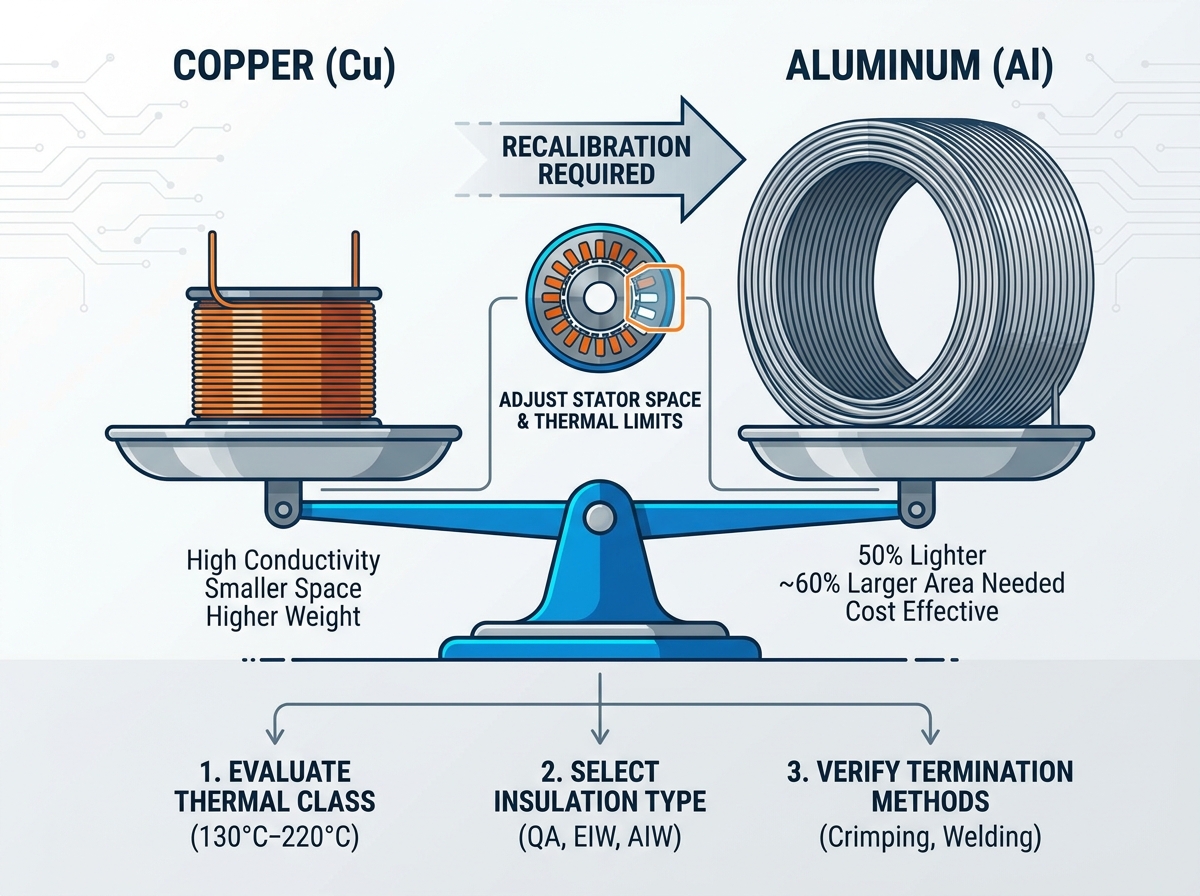
Substituting copper with aluminum yields up to 50% weight reduction but requires a ~60% larger cross-sectional area to maintain equivalent conductivity.
Precise enameled round aluminum wire specifications—specifically thermal class and insulation thickness—dictate operational viability in high-load environments.
Successful implementation requires adjusting winding tension and utilizing specialized termination methods to prevent mechanical and galvanic failures.
Evaluating suppliers based on stringent IEC/NEMA compliance minimizes batch-to-batch dielectric inconsistencies.
Evaluating conductor materials requires a close look at the cost per ohm. Engineers traditionally measure material costs by weight. You buy aluminum by the kilogram, but you use it by volume inside a motor stator. Aluminum offers immense material cost savings compared to copper. However, achieving equivalent electrical resistance demands larger wire diameters. You must calculate the exact return on investment for each motor series. The initial material savings must justify the engineering time spent redesigning the stator.
Lower gross weight directly translates to end-product success in many industries. Automotive components benefit heavily from lighter motors. Electric vehicle (EV) auxiliary systems require strict weight management to extend battery range. Portable appliances also see massive benefits. A lighter handheld vacuum cleaner reduces user fatigue and improves market appeal. HVAC fans mounted on commercial rooftops demand less structural support when you reduce their overall motor weight. These scenarios make aluminum an incredibly attractive alternative.
Aluminum possesses a lower electrical conductivity than copper. It sits at approximately 61.5% of the International Annealed Copper Standard (IACS). This fundamental property means drop-in replacements rarely succeed. You must redesign the motor laminations to accommodate a larger slot area. A ~60% larger cross-sectional area is necessary to match the original copper resistance. Expanding the stator slots often reduces the magnetic steel volume. You have to balance the electrical layout carefully to prevent magnetic saturation. This trade-off is the core challenge of any copper-to-aluminum conversion project.
To ensure motor reliability, you must scrutinize exact enameled round aluminum wire specifications before finalizing a design. Proper selection prevents insulation failure.
Insulation temperature ratings typically range from 130°C to 220°C. You must map these ratings directly to your motor operating environments. Standard household fans might operate perfectly using Class 130 or 155 wire. Industrial motors demand much higher limits. Enclosed motors trap heat, making thermal class critical. Higher thermal classes prevent premature insulation degradation. For instance, Class 200 Polyamide-imide coatings excel in harsh, enclosed environments. They resist thermal aging significantly better than basic polyurethane.
The chemical makeup of the enamel coating dictates its mechanical and chemical resilience. Consider these primary options:
Polyurethane (QA/UEW): This chemistry is best for easy soldering in low-temperature applications. It auto-fluxes during soldering, eliminating the need to strip the wire mechanically. It usually maxes out around Class 155 or 180.
Polyesterimide (EIW): This serves as the standard for general motor applications. It perfectly balances thermal resistance and mechanical strength. It is highly versatile and cost-effective.
Polyamide-imide overcoated (EI/AIW): Engineers require this for heavy-duty motors. These motors often face high transient voltage spikes and severe mechanical winding stress. It provides the highest abrasion resistance available.
The thickness of the enamel layer directly impacts dielectric strength. Industry standards define this as the wire "build."
Grade 1 (Single Build): Offers the thinnest coating. It maximizes the space factor but provides minimal abrasion protection.
Grade 2 (Heavy Build): The industry standard for most motor windings. It balances slot fill requirements and strong dielectric protection.
Grade 3 (Triple Build): Features the thickest coating. It is mandatory for environments demanding extremely high dielectric breakdown voltages. Inverter-duty motors often utilize this grade to survive high-frequency voltage spikes.
Specifying aluminum magnet wire for motors requires aligning the wire properties with the final product's operational duty cycle.
Washing machines, vacuum cleaners, and standard fan motors are ideal candidates for aluminum conductors. These consumer goods usually face intense cost sensitivity. Manufacturers fiercely defend their profit margins on household appliances. Furthermore, physical space inside these appliance chassis is often less constrained. This extra space easily accommodates the larger stator slots required for aluminum. The relatively predictable duty cycles also prevent extreme thermal overloads.
HVAC motors and refrigeration compressors present a unique chemical challenge. The winding wire submerges directly into refrigerant gases and compressor oils. You must select hermetic-grade enamel coatings for these applications. Standard enamels blister or dissolve in Freon and modern synthetic refrigerants. Polyamide-imide overcoats typically provide the necessary chemical resistance. Failing to specify refrigerant-resistant enamel leads to catastrophic short circuits deep inside the compressor housing.
The automotive industry aggressively pursues lightweighting to improve vehicle efficiency. EV auxiliary motors—such as power steering pumps and cooling fans—benefit immensely from lighter coils. However, vehicles endure constant road vibration and wide temperature swings. You must focus on vibration resistance when selecting the wire. The insulation must withstand constant microscopic rubbing inside the stator slots. Heavy build coatings and specialized winding resins help secure the coils against this relentless automotive vibration.
Proper enameled aluminum round wire selection extends beyond just electrical properties. You must solve several mechanical manufacturing hurdles.
Aluminum exhibits noticeably lower mechanical tensile strength compared to copper. This softness changes how the wire behaves on the factory floor. Modern automated winding machines apply significant tension to achieve tight coils. If you apply copper-level tension to an aluminum wire, the conductor will stretch. This stretching causes "necking," where the wire diameter shrinks and electrical resistance spikes. In worst-case scenarios, the wire snaps entirely. You must strictly verify wire elongation limits. Calibrate your winding machine tensioners specifically for aluminum's yield strength.
Aluminum rapidly forms a tough, non-conductive oxide layer when exposed to air. This oxidation layer ruins standard soldering attempts. You cannot simply twist and solder aluminum wires as you do copper. We recommend utilizing specialized termination strategies:
Mechanical Crimping: Use piercing terminals designed specifically for aluminum. These terminals feature sharp internal serrations. The serrations bite through the enamel and the oxide layer to create a gas-tight electrical connection.
Ultrasonic Welding: High-frequency vibrations scrub away the oxide layer while simultaneously fusing the metals. It creates a highly reliable solid-state bond.
Chemical Fluxes: If soldering is unavoidable, you must use highly aggressive, specialized fluxes. These fluxes dissolve the oxide layer right before the solder flows. Ensure you clean all flux residue to prevent future corrosion.
Aluminum expands and contracts significantly more than copper during thermal cycling. A motor heats up under load and cools down when deactivated. This continuous thermal expansion poses a massive risk to standard mechanical connections. Over thousands of cycles, the connection can loosen. A loose connection increases resistance, generates localized heat, and eventually melts the terminal. Ensure your selection framework evaluates compatible crimp materials. Use terminals engineered to flex and maintain constant pressure on the aluminum conductor.
To ensure long-term reliability, avoid these common implementation errors:
Mixing standard copper lugs with aluminum wire. This invites severe galvanic corrosion.
Failing to apply antioxidant joint compounds inside mechanical crimps.
Overtightening mechanical fasteners, which crushes the soft aluminum conductor.
Consistency is the foundation of motor reliability. You must shortlist vendors strictly adhering to global manufacturing standards. Demand compliance to IEC 60317-0-3 or NEMA MW 1000 standards. These documents dictate the baseline acceptable physical and electrical properties for aluminum magnet wire. A vendor lacking these certifications introduces unacceptable risk into your supply chain.
Never rely on verbal quality assurances. Demand verifiable, batch-level data from your suppliers. You need documentation on high-voltage breakdown thresholds. Additionally, require data on pinhole counts per meter. Pinholes are microscopic gaps in the enamel coating. Too many pinholes dramatically increase the risk of turn-to-turn short circuits. High-quality vendors routinely test their wire in saltwater baths to detect and document these hidden pinholes.
Poor packaging ruins high-quality wire. Evaluate the vendor's winding precision on the delivery spools. Standard industrial sizes like PT-90 or PT-200 spools require perfectly level winding. Tangled wire causes immense problems. Unevenly tensioned spools cause the wire to snag during high-speed automated motor manufacturing. This snagging leads to immediate wire breaks and high scrap rates. Inspect sample spools closely for smooth, uniform layers.
Assess supply chain reliability carefully. Standard copper wire is highly commoditized and easily available. Specialized aluminum configurations often require custom enamel builds or non-standard diameters. Discuss Minimum Order Quantities (MOQs) early in the negotiation process. Ensure the vendor can meet your production ramp-up schedules without unacceptable lead times.
Evaluation Criteria | Ideal Vendor Response | Red Flags to Watch Out For |
|---|---|---|
Standard Compliance | Full IEC 60317-0-3 / NEMA MW 1000 certification. | Only internal company standards provided. |
Quality Documentation | Batch-specific dielectric & pinhole test reports. | Refusal to share lot-specific testing data. |
Spooling Quality | Level-wound PT-90 / PT-200 spools. | Visible gaps, overlaps, or loose wire on spools. |
Technical Support | Direct access to application engineers. | Sales-only contacts unable to discuss chemistry. |
Selecting the correct enameled aluminum wire is not a 1:1 copper swap. It represents a systemic engineering decision that impacts the entire motor design. You must account for lower conductivity by increasing slot sizes. You must adjust your manufacturing lines to handle lower tensile strengths. Prioritizing thermal stability and mechanical termination compatibility yields the highest long-term return on your material investment.
Do not finalize your designs based on theoretical data alone. We advise all buyers to consult directly with application engineers. Request comprehensive technical data sheets (TDS) for the specific enamel chemistry you intend to use. Order sample spools for prototyping. Run your own destructive breakdown testing and thermal cycling to validate the system completely.
A: A standard rule of thumb exists for this conversion. You should increase the aluminum wire diameter by approximately 1.26 times the original copper diameter. This simple calculation helps you match the original electrical resistance. However, always verify this theoretical sizing against your available stator slot space to ensure proper fit.
A: The maximum temperature depends entirely on the chemical enamel coating. Standard polyurethane coatings generally support 130°C to 155°C. High-grade polyamide-imide overcoats easily withstand up to 220°C. You must match the coating chemistry to your motor's thermal class requirements to prevent melting.
A: You can solder it directly only if it features a self-fluxing polyurethane enamel (typically rated up to Class 180). Otherwise, standard enamels demand mechanical stripping. Because aluminum oxidizes rapidly, specialized fluxes are mandatory during soldering. Mechanical crimping often provides a more reliable alternative to soldering.
A: It does not degrade faster if specified and installed correctly. Premature motor failure usually stems from improper termination methods or exceeding the thermal class limits of the enamel. The aluminum conductor itself remains highly stable when protected from extreme mechanical stress and galvanic corrosion.