Views: 0 Author: Site Editor Publish Time: 2026-08-09 Origin: Site
In high-voltage and high-temperature transformer design, conductor insulation failure drives catastrophic equipment loss. Standard insulation materials degrade under peak thermal loads or mechanical stress during the winding process. Specifying the wrong conductor geometry or insulation build leads to poor window fill factors, partial discharge, or thermal breakdown. Engineers must balance dielectric requirements with spatial constraints and manufacturability to ensure long-term operational stability.
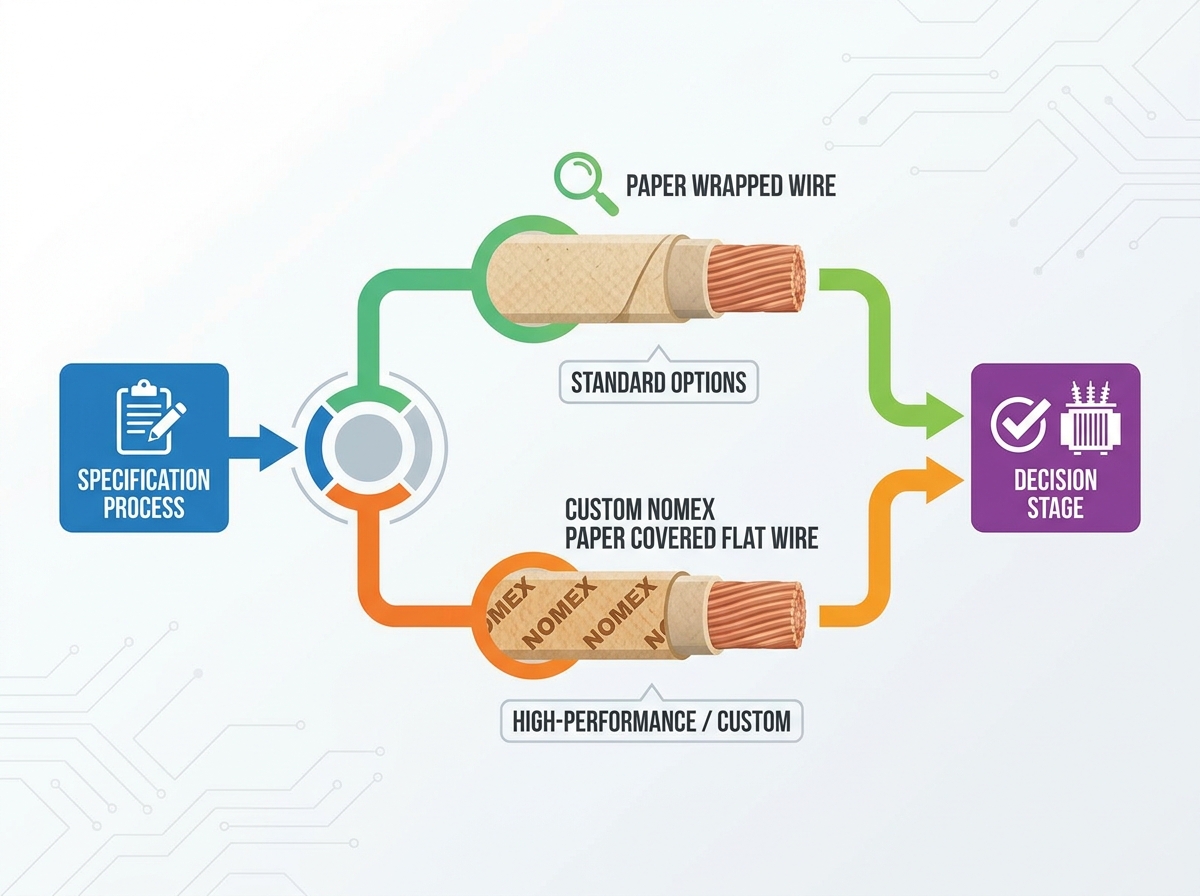
Navigating the technical specifications of paper wrapped wire requires a rigorous approach to dimensional tolerances, wrapping configurations, and material properties. This guide details the exact parameters required to specify Nomex-insulated flat wire for reliable transformer manufacturing. We will cover how to optimize core window utilization, manage thermal performance, and prevent insulation damage during tight-radius winding.
Nomex insulation elevates the thermal rating of transformer windings to Class 220 (220°C), significantly outperforming standard Kraft paper in overload conditions and dry-type applications.
Precise specification of flat wire geometry—specifically width-to-thickness ratios and corner radii—is critical to preventing insulation damage during tight-radius winding.
Insulation build must be specified not just by total thickness, but by wrapping configuration (e.g., 30% overlap, butt-lap) to ensure consistent dielectric strength without compromising the core window fill factor.
Procuring custom Nomex paper covered flat wire requires evaluating supplier capabilities in tension control, continuous length production, and adherence to IEC/NEMA testing standards.
Transformer designers must select insulation that withstands operational thermal cycling and the mechanical rigors of the winding machine. Evaluating conventional cellulose materials against advanced aramid polymers reveals stark differences in lifecycle reliability. Field failures often trace back to insulation that could not handle the physical stress of manufacturing or the thermal stress of peak loads.
The thermal degradation curves of Nomex (aramid paper) and standard cellulose (Kraft) paper diverge sharply at elevated temperatures. Kraft paper typically limits a transformer to a Class 105 or Class 120 thermal rating. Prolonged exposure to temperatures above these thresholds accelerates cellulose depolymerization. The paper becomes brittle and loses its mechanical and dielectric integrity. Nomex maintains its electrical and mechanical properties continuously at 220°C (Class 220).
This high thermal rating directly impacts the transformer footprint. By tolerating higher operating temperatures, you can push higher current densities through the conductors. This enables smaller, higher-capacity designs. During transient overload conditions, Nomex resists embrittlement. The insulation does not crack when subjected to the electromagnetic forces of a short-circuit event later in the equipment's lifecycle.
Comparison of Kraft Paper vs. Nomex Insulation | ||
Property | Standard Kraft Paper | Nomex (Aramid Paper) |
|---|---|---|
Thermal Class | Class 105 / 120 (105°C - 120°C) | Class 220 (220°C) |
Moisture Absorption | High (Requires extensive vacuum drying) | Low (Minimal drying required) |
Mechanical Toughness | Moderate (Prone to tearing on sharp radii) | High (Excellent tear resistance) |
Dielectric Strength | Good (Decreases rapidly with moisture) | Excellent (Stable across temperature ranges) |
The inherent dielectric strength of aramid paper far exceeds standard cellulose alternatives. Nomex provides a robust dielectric barrier even at reduced thicknesses. This allows designers to minimize the radial insulation build and maximize copper fill within the core window. You get more conductive material into the same physical space without sacrificing voltage withstand capabilities.
Moisture resistance is another major factor. Cellulose is highly hygroscopic. It requires extensive and carefully controlled vacuum drying cycles before impregnation to prevent moisture-induced dielectric failure. Nomex absorbs significantly less moisture. This streamlines the manufacturing process and reduces the risk of residual water compromising the insulation system. Aramid paper also exhibits excellent chemical compatibility with common transformer fluids, including mineral oil, silicone, synthetic ester fluids, and dry-type casting resins.
Winding large transformer coils subjects the conductor and its insulation to severe mechanical stress. Nomex possesses superior tear resistance and elongation properties compared to Kraft paper. This mechanical toughness reduces fault rates caused by insulation cut-through on the corners of flat wire during high-tension winding.
When forming tight radii, standard paper can tear or separate. This exposes the bare conductor and creates a localized weak point susceptible to partial discharge. The structural integrity of Nomex ensures the dielectric barrier remains uniform across the entire coil geometry, even under aggressive winding tensions. Operators can run winding machines at higher speeds with fewer stops for insulation repair.
Defining the exact physical and electrical parameters required for the bill of materials is essential for successful transformer manufacturing. Every dimension and material choice directly influences the final electrical performance and physical fit. You cannot rely on generic specifications if you want predictable manufacturing yields.
The choice between copper and aluminum involves strict conductivity-to-volume trade-offs. Copper offers superior electrical conductivity. It allows for a smaller cross-sectional area for a given current rating. This reduces the overall core window required, leading to a more compact transformer. Aluminum requires a larger cross-section to achieve the same ampacity, but it significantly reduces the weight and material cost of the winding.
Yield strength considerations also play a role. Aluminum is softer than copper. This can be advantageous during the winding process as it bends more easily. However, this softness means the conductor is more prone to stretching under tension. Stretching distorts the paper wrap. Copper provides a more rigid substrate, maintaining its cross-sectional profile better under winding stresses.
Determining the target cross-sectional area requires calculating the continuous current rating against the allowable current density. Minimizing copper loss is paramount for achieving high efficiency. You must balance temperature rise constraints with the overall winding window limits.
Determine the maximum continuous RMS current for the winding.
Select a target current density (e.g., 2.5 to 4.0 A/mm² for copper, depending on cooling).
Divide the RMS current by the current density to find the required bare conductor cross-sectional area.
Adjust the dimensions to fit standard or custom flat wire profiles while maintaining the required area.
A higher current density reduces the required conductor size but increases internal heat generation. Utilizing Nomex insulation allows for a higher allowable temperature rise. This gives designers the flexibility to increase current density and reduce conductor volume without risking insulation failure.
In high-frequency or harmonic-rich designs, standard heavy-gauge round wire suffers from severe AC resistance due to the skin effect and proximity effect. Flat wire geometry mitigates these losses by increasing the surface area relative to the cross-sectional volume. High-frequency currents distribute more evenly across the wide, flat surface.
Evaluating the transition from Litz wire or foil to custom Nomex paper covered flat wire is common in high-power magnetic components. Flat wire offers a practical middle ground. It provides better high-frequency performance than solid round wire while being easier to wind and terminate than wide copper foils. It also avoids the high termination costs associated with Litz wire.
Defining acceptable width-to-thickness ratios for flat wire prevents keystone effects during winding. If the wire is too wide relative to its thickness, bending it around the bobbin corners causes the inner edge to compress and the outer edge to stretch. This distorts the rectangular profile into a trapezoid, which damages the insulation and ruins the layer packing.
The corner radii of the bare conductor are equally critical. Sharp edges create high electrical stress concentrations. They act as mechanical cutting edges that compromise the dielectric barrier. Radius tolerances must be specified based on wire thickness. For example, a wire thickness of 2.0mm typically requires a corner radius of 0.5mm. Calculating the impact of these conductor tolerances on the overall window fill factor ensures the winding will physically fit into the core.
Translating Turns-Per-Volt calculations into the total required winding area dictates the physical dimensions of the coil. Calculating physical bobbin capacity requires accounting for the bare conductor dimensions, the insulation build, winding margins, and interlayer insulation.
A margin of safety must be applied to ensure primary and secondary windings fit within the core laminations. If the window fill factor exceeds practical limits (typically 70-80% for rectangular wire), the coil will not fit. This necessitates a complete redesign of the core or conductor profile. Always calculate the maximum possible dimensions based on the upper tolerance limits of the insulated wire.
Specifying the number of paper layers and the total radial build determines the turn-to-turn voltage withstand capability. Evaluating wrapping methods involves strict trade-offs between dielectric strength and space efficiency.
Common Wrapping Configurations for Flat Wire | |||
Wrapping Method | Description | Dielectric Strength | Space Efficiency |
|---|---|---|---|
Butt-Lap | Edges of the paper meet exactly without overlapping. | Moderate | Excellent (Minimal build) |
30% Overlap | Each turn overlaps the previous by 30%. | High | Good |
50% Overlap | Each turn overlaps the previous by half its width. | Very High | Fair (Thicker build) |
Intercalated | Multiple tapes applied simultaneously, overlapping each other. | Maximum | Low (Thickest build) |
Higher overlap percentages increase dielectric strength and provide superior mechanical protection against abrasion. They also increase the total diameter or profile of the wire, reducing the spatial efficiency of the winding. You must specify the exact wrapping configuration to ensure the manufacturer delivers a product that meets both electrical and dimensional requirements.
Evaluating manufacturers and balancing custom engineering with procurement realities ensures the specified materials arrive on time and meet quality standards. You need a supplier capable of holding tight tolerances over long continuous runs.
Standard AWG, SWG, or metric wire sizes often impose limitations on optimized high-efficiency transformer designs. Forcing a standard size into a design can result in suboptimal fill factors or excessive copper losses. Conducting a cost-benefit analysis of ordering custom profiles helps achieve exact impedance and loss targets.
Custom dimensions allow engineers to utilize every available millimeter of the core window. Custom runs have higher upfront costs, but the resulting improvements in transformer efficiency and material utilization justify the investment. You save money on core steel and enclosure sizing by optimizing the copper fill.
Assessing vendor wrapping technology is mandatory. Automated tension control prevents paper wrinkling, gaps, or overlapping inconsistencies. Uneven tension creates weak points in the dielectric barrier that fail under high voltage testing.
Continuous length limits and spooling options must be evaluated to minimize splicing in primary and secondary coils. Splices introduce mechanical bulk and electrical discontinuities. Verify the manufacturer's testing protocols. Require routine tests for dielectric breakdown, adherence, and dimensional verification, ensuring compliance with standards like IEC 60317-27 or NEMA MW 33-C.
Custom aramid-wrapped profiles typically require minimum order quantities that exceed standard off-the-shelf wire. Planners must account for these MOQs when forecasting production runs. Ordering too little results in high per-kilogram costs, while ordering too much ties up capital in specialized inventory.
Implementing strategies for standardizing internal designs helps consolidate wire profiles. By using a few carefully selected custom profiles across multiple transformer models, companies meet MOQs more easily and reduce overall lead times. Work with your engineering team to find overlapping current requirements across different product lines.
Addressing common failures during the manufacturing phase prevents costly rework and ensures the final product operates safely in the field. Even the best materials fail if handled incorrectly on the winding floor.
Excessive tension during coil winding causes paper elongation. This thins the dielectric barrier or physically tears the insulation to expose the bare conductor. It is a primary cause of turn-to-turn shorts during routine testing.
Mitigate this risk by specifying maximum allowable winding tension based on the conductor's yield strength and the aramid paper's tensile limits. Calibrate winding machines regularly. Use dynamic tensioners to maintain consistent force throughout the coil building process, especially when winding rectangular coils where tension spikes at the corners.
Poor penetration of Vacuum Pressure Impregnation resins through dense paper layers leaves voids within the coil. These voids trap air, leading to partial discharge and eventual thermal breakdown. The resin must fully saturate the paper to create a solid, void-free insulation system.
Specify the correct paper porosity and wrap tension to allow optimal resin flow. Nomex is available in different densities. Selecting a highly calendered paper restricts resin flow. A more porous grade facilitates complete impregnation without creating voids. Ensure your chosen resin (epoxy or polyester) is chemically compatible with the specific aramid paper grade.
Contamination or moisture ingress prior to winding compromises the insulation's dielectric strength. Dust, metal shavings, or high humidity degrade the paper wrap before it enters the transformer. Nomex is less hygroscopic than Kraft paper, but it still requires proper storage.
Establish strict climate-controlled storage requirements. Specify protective packaging from the wire manufacturer, such as sealed plastic wrapping with desiccants. Ensure spools are handled with care to prevent physical damage to the outer layers of wire. Never roll spools on their flanges across dirty factory floors.
A: Nomex paper wrapped wire is rated for Class 220. It operates continuously at 220°C without significant thermal degradation. This far exceeds standard Kraft paper, which is limited to Class 105 or Class 120.
A: Insulation build is calculated by multiplying the thickness of a single layer of paper by the number of layers, then adjusting for the wrapping configuration. A 50% overlap effectively doubles the number of layers present at any given point on the conductor.
A: Kraft paper is a cellulose-based material that degrades at high temperatures and absorbs moisture easily. Nomex is a synthetic aramid polymer offering superior thermal stability up to 220°C, higher dielectric strength, and excellent resistance to moisture and chemicals.
A: Sharp corners on flat wire create high mechanical stress that cuts through paper insulation during winding. They also concentrate electrical fields. A properly specified, smooth corner radius prevents insulation damage and ensures uniform dielectric strength.
A: Common overlap percentages are 30% and 50%. A 30% overlap provides a good balance of dielectric protection and space efficiency. A 50% overlap offers maximum mechanical and electrical protection at the cost of a thicker overall wire profile.
A: Flat wire provides a superior window fill factor compared to round wire. Rectangular profiles pack more densely with less wasted space. It handles high currents more efficiently and reduces AC resistance caused by skin and proximity effects in high-frequency applications.