Views: 0 Author: Site Editor Publish Time: 2026-10-15 Origin: Site
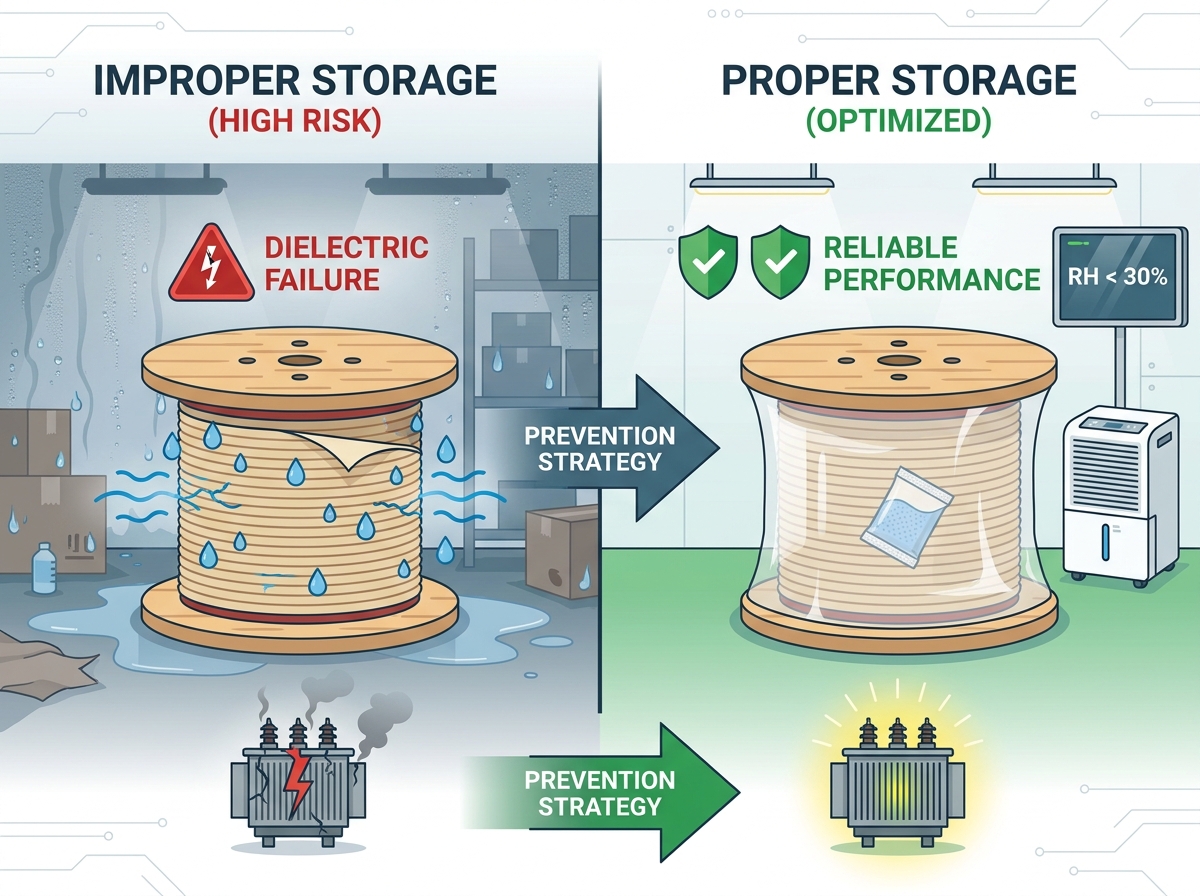
The reliability of a power transformer is largely dictated before the winding process even begins. Improper storage practices routinely lead to moisture ingress. This drastically reduces dielectric strength and increases the risk of premature partial discharge.
Kraft paper is highly hygroscopic. Leaving spools in uncontrolled ambient conditions directly compromises the insulation system. It often leads to costly rewinding delays. You might experience failed factory acceptance tests or catastrophic field failures later. Treating these components carelessly guarantees poor equipment performance.
This guide outlines the evidence-based environmental controls, handling protocols, and facility requirements you need. We detail how to protect paper-covered magnet wire investments from delivery right up to the winding machine. You will learn to establish robust baselines and audit your current infrastructure.
Moisture is the primary threat: Kraft paper insulation rapidly absorbs atmospheric moisture; storage environments must strictly control Relative Humidity (RH) and dew points.
Physical integrity equals dielectric integrity: Proper transformer winding wire handling prevents micro-tears in the paper layers that environmental controls cannot fix.
Sealed packaging must remain intact: Factory-applied protective wrapping (vacuum seals, desiccants) should only be removed immediately before the winding process begins.
Pre-assembly QA is non-negotiable: Implementing baseline moisture testing before transformer assembly prevents compromised wire from entering the production line.
Cellulose naturally absorbs ambient moisture. Kraft paper consists of glucose polymer chains. These chains contain hydroxyl groups. Hydroxyl groups act like magnets for water molecules. When moisture content exceeds 0.5% by weight, the mechanical strength drops. The electrical resistance also plummets. Effective paper insulated wire storage prevents this exact degradation.
Water molecules form conductive paths inside the insulation matrix. These microscopic paths lower the system's breakdown voltage. They accelerate thermal aging during active transformer operation. A damp cellulose barrier cannot isolate high-voltage stresses. It eventually triggers localized tracking. This tracking escalates into destructive partial discharge.
Failure costs scale rapidly. Manufacturing delays severely impact delivery timelines. You waste expensive skilled labor on compromised materials. Scrapping heavily oxidized copper or aluminum drives project expenses higher. Failed quality assurance testing means you must dismantle the entire core. Prevention demands a much smaller investment than remediation.
Baseline benchmarks demand strict temperature and humidity parameters. Facilities should maintain relative humidity below 30% to 40%. Ambient temperatures must remain stable. Condensation happens quickly when temperatures fluctuate. Excellent moisture control for paper covered wire keeps the environment predictable.
Dew point management often supersedes simple temperature control. The dew point defines when airborne vapor turns into liquid water. A sudden warehouse temperature drop creates microscopic condensation on cold wire spools. Copper conducts thermal energy efficiently. It cools down fast, turning the spool into a condensation trap. Managing the dew point prevents this invisible threat.
Evaluating storage solutions requires balancing budget and performance. Climate-controlled rooms offer the highest security level. They isolate materials from factory floor conditions. Industrial dehumidification systems keep the air uniformly dry. However, dedicated rooms consume significant floor space.
Heated storage enclosures provide a smaller footprint alternative. They use localized heating to elevate the wire temperature slightly above ambient room conditions. Warmer surfaces repel moisture settling. This strategy works well for intermediate staging areas. It prevents overnight dew point crossovers efficiently.
Paper insulation is highly robust inside a finished, compressed transformer matrix. However, it remains exceedingly fragile on a standalone spool. Abrasions ruin the dielectric barrier. Compression damage crushes the paper fibers. Operators must treat the raw material like a delicate electronic component. Faulty transformer winding wire handling ruins perfectly dry materials.
Facilities must enforce strict transport and lifting standard operating procedures (SOPs). Forklift tines cause severe damage. One accidental gouge destroys multiple outer layers. Operators should use specialized reel handlers instead. Synthetic lifting straps distribute weight safely.
Inspect lifting equipment daily: Ensure synthetic straps have no frayed edges. Frayed edges can snap under heavy copper loads.
Avoid direct tine contact: Never insert bare metal forklift tines directly into the spool bore unless using an approved mandrel attachment.
Verify spool orientation: Mandate vertical or horizontal positioning based precisely on manufacturer specifications. Incorrect orientation causes wire shifting. Tangling occurs when loose wires overlap.
Secure the transit path: Clear the route between the storage room and the winding machine. Bumps or drops induce severe mechanical stress.
Contamination prevention deserves equal attention. The staging area must remain pristine. Metallic dust from nearby grinding stations is lethal. It embeds deeply into the porous paper. Chemical vapors degrade the cellulose polymer chains over time. Oil splatters create localized hot spots. You must isolate wire storage far away from machining or welding zones.
Staging requirements differ vastly based on production timelines. Short-term storage covers materials scheduled for use within 48 hours. We call this a Just-In-Time staging protocol. You move the spools to the winding floor. The golden rule applies here: do not break the manufacturer's stretch wrap. Leave the protective outer layer intact until the operator mounts the spool onto the tensioner.
Long-term storage protocols address delayed projects or bulk ordering. Delays happen frequently in heavy manufacturing. You need robust solutions to preserve the wire for months. Vacuum-sealed barrier bags provide excellent defense. They block atmospheric moisture entirely. Nitrogen-purged enclosures remove oxygen, halting copper oxidation while keeping the paper dry.
Industrial desiccants act as the final defense line inside sealed packaging. Procurement teams must source high-capacity silica gels. QA operators must inspect desiccant color-indicators weekly. Pink or green indicators mean moisture saturation. Blue or orange indicates dry conditions. Continuous data-logging sensors track temperature and humidity inside the storage zone.
Storage Duration | Packaging Protocol | Environmental Control | Inspection Frequency |
|---|---|---|---|
Short-Term (< 48 hours) | Keep factory wrap fully intact. | Staged in ambient (if climate-controlled factory). | Inspect outer wrap before mounting. |
Medium-Term (2 days to 1 month) | Repackage in vapor barrier bags if seal broken. | Store in dedicated dehumidified room. | Weekly checks on desiccant indicators. |
Long-Term (> 1 month) | Vacuum-sealed bags or nitrogen purge. | Heated enclosures or strict climate rooms. | Continuous data-logging required. |
Pre-assembly quality assurance prevents doomed materials from entering the production line. A rigorous inspection checklist protects your bottom line. Operators must assess every spool before committing it to a core. Visual checks identify damaged paper layers immediately. Loose winding indicates shifting during transit. Compromised packaging requires immediate isolation of the spool.
Moisture verification becomes critical if the storage seal breaks. You cannot rely on visual inspections for water ingress. Technicians must verify the moisture content directly. They often use laboratory titration methods on scrap wire ends. Dielectric response analysis offers another testing vector. These methods confirm whether the paper remains within the safe 0.5% moisture threshold.
Remediation realities often force tough financial decisions. The "re-baking" question arises frequently. Can you salvage moisture-compromised wire? Yes, vacuum drying ovens can extract water from the spool. However, baking consumes massive energy. It disrupts production schedules entirely. Prolonged heat exposure also ages the paper prematurely. Scrapping heavily saturated wire often proves cheaper than complex remediation. Prevention always outperforms salvage attempts.
Procurement and QA teams need a clear framework for auditing facilities.
Audit the HVAC system: Confirm the dehumidifiers handle seasonal humidity spikes.
Review handling gear: Discard damaged lifting straps. Purchase specialized mandrel attachments for forklifts.
Train the workforce: Educate operators on cellulose hygroscopic physics. Explain why sweaty hands ruin insulation.
Implement data logging: Install smart sensors in the storage area. Set automated alarms for temperature drops.
Successful transformer manufacturing relies entirely on treating paper-insulated wire as a highly sensitive component. It is never just bulk raw material. Cellulose acts like a sponge, demanding rigorous climate management. Strict environmental controls prevent disastrous moisture ingress. Precise handling SOPs eliminate mechanical micro-tears.
We encourage you to audit your current wire storage facilities immediately. Upgrade your warehouse moisture control systems. Invest in proper synthetic lifting gear. Consult insulation specialists to establish facility-specific protocols. Taking these proactive steps ensures higher dielectric strength, faster production times, and reliable power transformers.
A: Factory-sealed spools can last indefinitely if environmental conditions remain perfect. The vacuum seals must remain completely intact. The storage facility must hold steady temperatures and low humidity. Once you break the seal, the safe storage window drops to mere hours unless you move the spool into a dedicated dry room.
A: The kraft paper absorbs moisture rapidly. This water acts as a conductive path, destroying dielectric strength. Manufacturers must then execute extensive vacuum drying during the active part drying phase. This drastically increases manufacturing time, raises energy costs, and accelerates the paper's thermal aging.
A: Yes, bare hands cause immediate damage. Human skin transfers natural oils, dirt, and sweat directly into the porous cellulose. These contaminants create localized electrical stress points. Operators must always wear clean cotton gloves during handling, staging, and active winding.
A: The ideal relative humidity sits securely below 30% to 40%. You must pair this low humidity with highly stable ambient temperatures. Stable temperatures prevent sudden dew point crossovers. Keeping the air dry and warm ensures water vapor never condenses on the cold copper spools.