Views: 0 Author: Site Editor Publish Time: 2026-08-02 Origin: Site
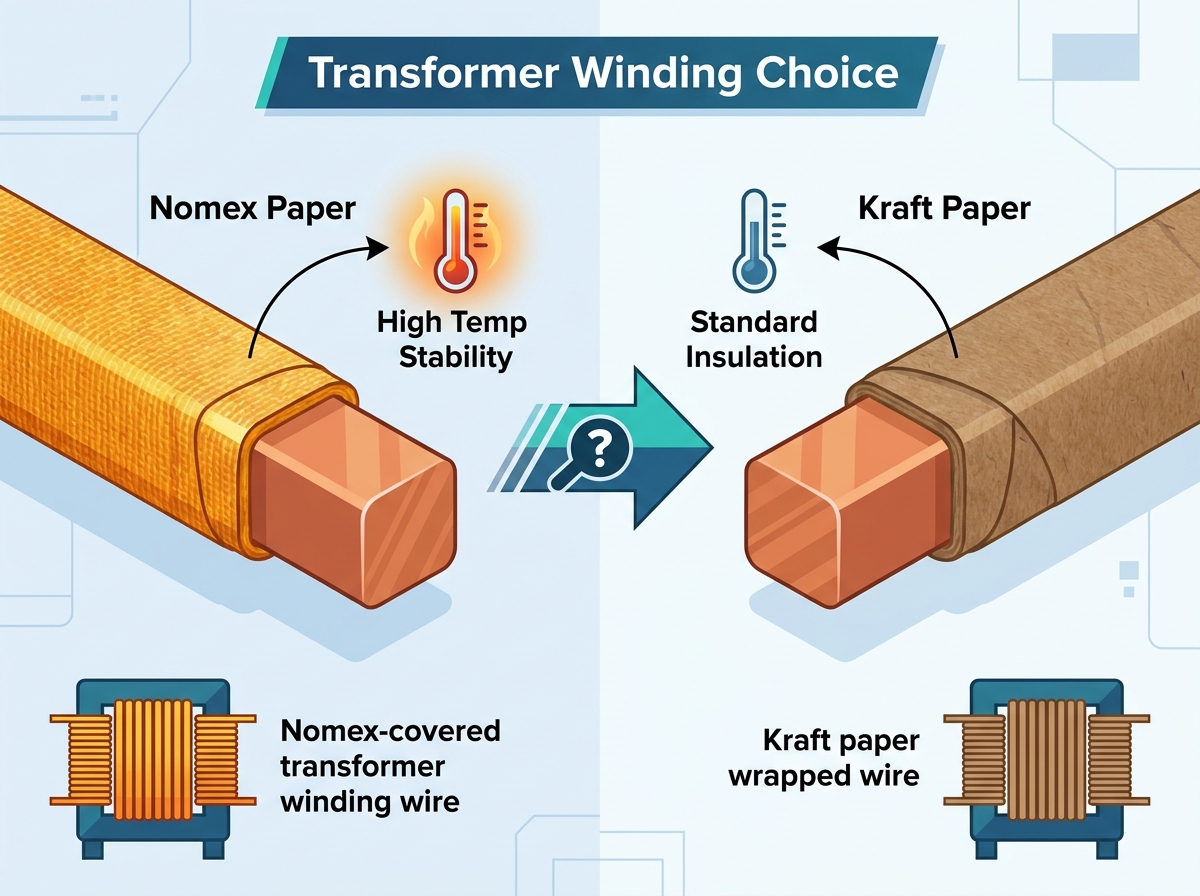
The reliability, overload capacity, and operational lifespan of a transformer are fundamentally dictated by the integrity of its winding insulation under continuous thermal and electrical stress. Engineering and procurement teams must balance strict thermal performance requirements and dielectric strength with manufacturing practicalities, especially in high-voltage or high-load applications where insulation failure leads to catastrophic asset loss. Evaluating the technical and economic trade-offs between traditional Kraft paper wrapped wire and advanced synthetic alternatives like Nomex-covered transformer winding wire is essential to determine the optimal insulation strategy for specific transformer designs. We will look at how these materials handle thermal degradation, mechanical stress, and moisture ingress. You can use this data to design transformers that withstand peak load spikes and harsh operating conditions without failing prematurely. Selecting the correct insulation directly impacts the structural stability and longevity of the entire electrical system.
Thermal Superiority: Advanced aramid-based papers offer significantly higher thermal class ratings—often performing at least 20°C better in mineral oil systems compared to standard cellulose options.
Dielectric Efficiency: Synthetic and hybrid insulation materials can provide up to 30% higher AC dielectric strength, enabling thinner insulation layers and more compact winding designs.
Lifecycle Economics: While traditional cellulose remains the economical standard for baseline applications, premium synthetic insulation justifies its upfront cost through extended asset life, peak load resilience, and reduced overall transformer footprint.
Manufacturing Impact: Material selection directly influences winding structural integrity, chemical aging resistance, and the required drying and impregnation cycles during production.
Transformer winding insulation must meet strict performance thresholds to ensure long-term reliability. The first metric is the thermal degradation threshold. Engineers establish a baseline for the acceptable degree of polymerization (DP) loss over time. New Kraft paper typically starts with a DP value around 1000 to 1200. As insulation ages under thermal stress, the cellulose chains break down, and the DP value drops. When the DP reaches 200, the paper loses its mechanical strength and becomes brittle. This directly impacts the expected lifecycle of the transformer. Monitoring this degradation helps operators predict end-of-life scenarios and plan replacements before catastrophic failure occurs.
Mechanical stress endurance is equally important. During short-circuit conditions, transformers experience immense radial and axial forces. The magnetic fields generate physical movement within the coils. The insulation must withstand these violent shifts without tearing or compromising the dielectric barrier. If the paper tears, the bare copper or aluminum conductors will arc, leading to immediate failure. Furthermore, chemical compatibility plays a vital role. You must assess the long-term stability and aging characteristics of the insulation when submerged in mineral oils, ester fluids, and alternative dielectric coolants. The paper must not react with the oil or release contaminants that could lower the fluid's dielectric breakdown voltage.
To evaluate winding insulation success, engineers rely on specific testing protocols:
Conducting accelerated aging tests in sealed ampoules to simulate decades of thermal stress.
Measuring the tensile strength of the paper before and after oil immersion.
Testing the dielectric breakdown voltage using ASTM D149 standards.
Analyzing dissolved gases in the oil to detect early signs of cellulose degradation.
It is necessary to distinguish between different types of insulation within a transformer. Winding-level insulation provides direct, continuous dielectric separation between individual turn-to-turn conductors. This is where paper wrapped wire excels. Manufacturers wrap the paper tightly around the copper or aluminum conductors to prevent electrical shorts within the coil. The wrapping process requires precise tension to ensure the paper conforms tightly to the conductor without tearing or leaving air gaps. These air gaps can cause partial discharge, which slowly eats away at the insulation over time.
Structural components serve a different purpose. These include pressboard barriers, spacers, collars, and phase-to-phase insulation blocks. While winding wire insulation focuses on the micro-level separation of active conductors, structural insulation maintains the macro-level geometry of the core and coils. Structural components bear the physical weight of the windings and provide the necessary spacing for cooling fluid to circulate. Both systems must work together to maintain total dielectric integrity. If the structural spacers compress too much over time, the windings can shift, putting excessive mechanical strain on the conductor insulation.
Standard Kraft paper is a highly refined cellulose-based insulation. It has a long historical track record and provides reliable baseline dielectric properties for standard distribution transformers. The manufacturing process involves washing and refining wood pulp to remove impurities like lignin, which can degrade electrical performance. Cellulose is highly effective in oil-immersed environments. It absorbs the dielectric fluid, which displaces air within the paper matrix and significantly enhances its insulating capabilities. The oil and paper work as a composite insulation system.
However, cellulose has inherent thermal limitations. Standard Kraft generally operates safely up to a thermal class of 105°C. Thermally Upgraded Kraft (TUK) undergoes chemical treatment to improve nitrogen content, pushing its thermal limit to 120°C. Manufacturers add stabilizing agents like dicyandiamide to slow down the thermal degradation process. Despite this upgrade, cellulose experiences accelerated degradation kinetics in high-load or high-ambient environments. Continuous exposure to temperatures beyond its rating rapidly breaks down its molecular structure, releasing water and carbon dioxide into the oil, which further accelerates the aging cycle.
Synthetic meta-aramid polymers offer a radically different approach to insulation. These materials possess an inherent molecular resistance to chemical aging, moisture adsorption, and thermal breakdown. They do not degrade in the same way cellulose does when exposed to extreme heat. The chemical bonds in aramid fibers require significantly more energy to break, allowing them to maintain their structural integrity at temperatures that would turn Kraft paper to ash. This makes them ideal for applications where transformers must operate near their maximum load capacity for extended periods.
Specialized formulations, such as Nomex 910, are engineered specifically to optimize performance in oil-filled transformers. These hybrid liquid-immersed solutions combine cellulose-based structures with aramid fibers. This creates a material that offers superior fluid compatibility while drastically raising the thermal and dielectric ceilings of the winding wire. The aramid component provides the high-temperature backbone, while the cellulose component ensures the paper absorbs the mineral oil effectively. This hybrid approach gives engineers the best of both worlds, allowing for higher operating temperatures without sacrificing the proven benefits of oil impregnation.
In dry-type and low-voltage layer-wound systems, alternative sheet materials are often utilized. Traditional vulcanized fiber, commonly known as fish paper, provides a robust physical barrier. It is tough, flexible, and resists mechanical abrasion during the winding process. Polyester films like Mylar® offer excellent dielectric strength and moisture resistance. However, these materials lack the specific fluid absorption characteristics required for high-voltage oil-immersed applications. If used in oil, they can block the flow of fluid and create localized hot spots within the winding.
NMN (Nomex-Mylar-Nomex) triplex laminates combine the thermal resistance of aramid paper with the dielectric strength of polyester film. You will typically find NMN composite insulation used as slot, phase, and barrier insulation alongside conductor-level wrapped wires. This multi-layered approach ensures comprehensive protection across different stress points in the transformer. The outer Nomex layers protect the inner Mylar film from thermal degradation and mechanical damage, while the Mylar provides an impenetrable dielectric barrier. Manufacturers bond these layers together using high-temperature adhesives to prevent delamination during operation.
When quantifying thermal advantages, Nomex-covered transformer winding wire significantly outperforms standard and thermally upgraded Kraft. Aramid papers can handle continuous operating temperatures up to 220°C in dry conditions. In liquid-immersed systems, they consistently provide at least a 20°C thermal margin over TUK. This means a transformer designed with aramid insulation can run hotter without sacrificing its expected lifespan. Engineers calculate this thermal aging using the Arrhenius equation, which shows that every 6°C to 8°C increase in operating temperature halves the life of standard cellulose insulation.
This thermal margin directly translates into superior overload resilience. Transformers insulated with aramid materials can handle peak load spikes without accelerating insulation degradation. You eliminate the risk of thermal runaway, ensuring the transformer remains operational during unexpected grid demands. For example, during extreme weather events, power grids often experience sudden surges in demand. A transformer with standard Kraft paper might overheat and fail under these conditions, while a unit with aramid insulation will absorb the thermal shock and continue functioning safely.
Advanced synthetic papers like Nomex 910 exhibit approximately 30% higher AC dielectric strength compared to standard cellulose. This enhanced dielectric performance has a profound operational impact on transformer design. Dielectric strength measures the maximum voltage a material can withstand before breaking down and allowing current to pass through. A higher rating means the insulation provides a stronger barrier against electrical faults, even under severe electrical stress like lightning strikes or switching surges.
Higher dielectric strength allows engineers to optimize the copper fill factor. You can utilize thinner insulation layers on the conductors without sacrificing safety. This improves the core window fill factor, reduces overall winding resistance, and ultimately lowers copper losses. The result is a more efficient, compact transformer. When you reduce the thickness of the paper wrapped wire, you can fit more copper into the same physical space. This lowers the current density in the windings, which reduces the amount of heat generated during operation. It creates a compounding effect of improved efficiency and thermal management.
Over decades of continuous thermal cycling, insulation materials must retain their physical elasticity. Aramid papers maintain their tensile strength far better than Kraft paper, which tends to become brittle and prone to tearing as its DP value drops. When a transformer undergoes a short circuit, the windings experience massive electromagnetic forces. If the paper has become brittle from thermal aging, these forces will shatter the insulation, causing an immediate turn-to-turn fault. Aramid papers absorb these mechanical shocks, keeping the conductor safely isolated.
Moisture ingress is a critical threat to dielectric breakdown voltage. Cellulose papers are highly hygroscopic; they actively absorb moisture from the oil, which severely degrades their insulating properties. Even a small increase in moisture content (measured in parts per million) can halve the dielectric strength of Kraft paper. Aramid-based papers maintain superior dielectric properties in humid environments because they resist moisture absorption. They keep the winding secure over the long term, reducing the need for frequent oil dehydration maintenance.
Performance Metric | Standard Kraft Paper | Thermally Upgraded Kraft (TUK) | Nomex® Aramid Paper (e.g., 910) |
|---|---|---|---|
Thermal Class (Oil Immersed) | 105°C | 120°C | 130°C - 155°C+ |
AC Dielectric Strength | Baseline | Baseline | Up to 30% Higher |
Moisture Resistance | Poor (Highly Hygroscopic) | Poor (Highly Hygroscopic) | Excellent |
Mechanical Toughness Over Time | Degrades rapidly with heat | Moderate degradation | High retention of tensile strength |
Switching between cellulose and aramid papers requires adjustments on the factory floor. There are distinct differences in tear resistance, flexibility, and elongation. Winding machine tension settings must be carefully calibrated to accommodate synthetic papers, preventing material stretching or snapping during the wrapping process. Operators must adjust the braking systems on the paper spools to ensure a tight, uniform wrap around the conductor. If the tension is too loose, the paper will wrinkle and create voids. If it is too tight, the paper may stretch and lose its dielectric thickness.
Drying and impregnation cycles also require adaptation. Synthetic materials have different moisture release rates and oil-absorption characteristics compared to cellulose. Factory processing times for vapor phase drying (VPD) and oil impregnation must be modified to ensure the aramid fibers are fully saturated and free of trapped air pockets. The VPD process involves heating the active part of the transformer under a deep vacuum to extract moisture. Because aramid papers do not hold moisture like cellulose, the drying cycle can often be shortened, saving manufacturing time. However, the oil impregnation phase must be carefully monitored to ensure the fluid penetrates the denser synthetic matrix completely.
Key steps for adjusting manufacturing processes include:
Recalibrating winding machine tensioners for synthetic paper elongation limits.
Modifying vapor phase drying temperature profiles to match aramid moisture release rates.
Extending vacuum hold times during oil impregnation to ensure full saturation.
Conducting partial discharge testing on the first production units to verify void-free insulation.
Procuring advanced synthetic insulation introduces specific supply chain risks. Mitigating the risk of counterfeit or sub-standard synthetic papers is critical. You must enforce strict verification of raw material certifications from all suppliers to ensure the material meets exact engineering specifications. Counterfeit aramid papers may look identical to the genuine product but will fail catastrophically under thermal stress. Procurement teams must establish direct relationships with authorized distributors and demand certificates of analysis for every batch received.
Standardized testing protocols are non-negotiable. Utilize ASTM and IEC standards to verify thermal class, dielectric breakdown, and fluid compatibility before committing to full-scale production. Rigorous batch testing guarantees that the insulation will perform as expected in the field. Quality control labs should perform routine Fourier-transform infrared spectroscopy (FTIR) to verify the chemical composition of incoming paper shipments. This ensures that no inferior cellulose blends are passed off as high-performance aramid materials.
Evaluate your specific thermal class requirements and physical footprint constraints before selecting an insulation material. Consult with winding wire manufacturers to obtain material samples of both TUK and aramid-based options. Request specific dielectric fluid compatibility data from your suppliers. Execute thermal modeling simulations on proposed winding designs to verify that thinner synthetic insulation layers will safely improve your core window fill factor.
A: The primary advantage is superior thermal stability. Nomex operates safely at much higher temperatures, resisting chemical aging and mechanical breakdown far better than standard cellulose. This allows transformers to handle severe peak loads without risking premature insulation failure.
A: Nomex 910 provides at least a 20°C thermal advantage over TUK in mineral oil systems. It also delivers up to 30% higher AC dielectric strength, absorbing oil efficiently while resisting moisture degradation much better than traditional Kraft paper.
A: Yes. Because Nomex has higher dielectric strength, engineers can use thinner insulation layers. This improves the copper fill factor, allowing for more compact winding designs. The result is a smaller, lighter transformer that achieves the same or better power ratings.
A: NMN is a triplex laminate made of Nomex, Mylar, and Nomex. While conductor-level winding wire insulates individual turns, NMN is typically used for structural support, such as slot, phase, and barrier insulation, providing robust physical and dielectric separation between larger winding sections.
A: Kraft paper is highly hygroscopic; it absorbs moisture easily, which drastically lowers its dielectric strength and accelerates aging. Synthetic aramid paper resists moisture ingress, maintaining its dielectric integrity and physical toughness even in humid operating conditions.
A: No. While TUK improves upon standard Kraft by raising the thermal class to 120°C, it still degrades rapidly under extreme heat. Nomex is required for true high-temperature applications, offering continuous operation capabilities far beyond the limits of chemically treated cellulose.
A: Mechanical modifications are generally not required, but strict operational adjustments are necessary. Operators must recalibrate tension settings on winding machines because synthetic papers have different tear resistance, flexibility, and elongation properties compared to traditional cellulose.