Views: 0 Author: Site Editor Publish Time: 2026-10-01 Origin: Site
Electrical engineers face a high-stakes decision when sizing magnet wire for extreme-stress applications. Prime examples include EV traction motors, aerospace actuators, and high-efficiency transformers. You simply cannot afford insulation failures in environments pushing the absolute limits of material science. Selecting the wrong insulation resin triggers immediate, cascading problems. These failures include severe thermal overload, rapid chemical breakdown from automotive fluids, and catastrophic mechanical snapping during high-speed winding operations. A single miscalculation often turns into widespread motor shorts.
We will establish a clear, evidence-based framework for evaluating polyamide imide vs polyesterimide wire. You will learn to look beyond basic thermal class ratings. We explore practical implementation challenges and strict compliance realities. This guide equips you to navigate modern specification demands confidently.
Thermal Ceilings: Polyesterimide (PEI) is typically rated for Class 180 to Class 200, whereas Polyamide-Imide (PAI) achieves Class 220, offering superior thermal margin for overload conditions.
Mechanical Resilience: PAI enamel wire insulation provides exceptional scrape resistance and toughness, essential for tight radius bends and high-speed automated winding.
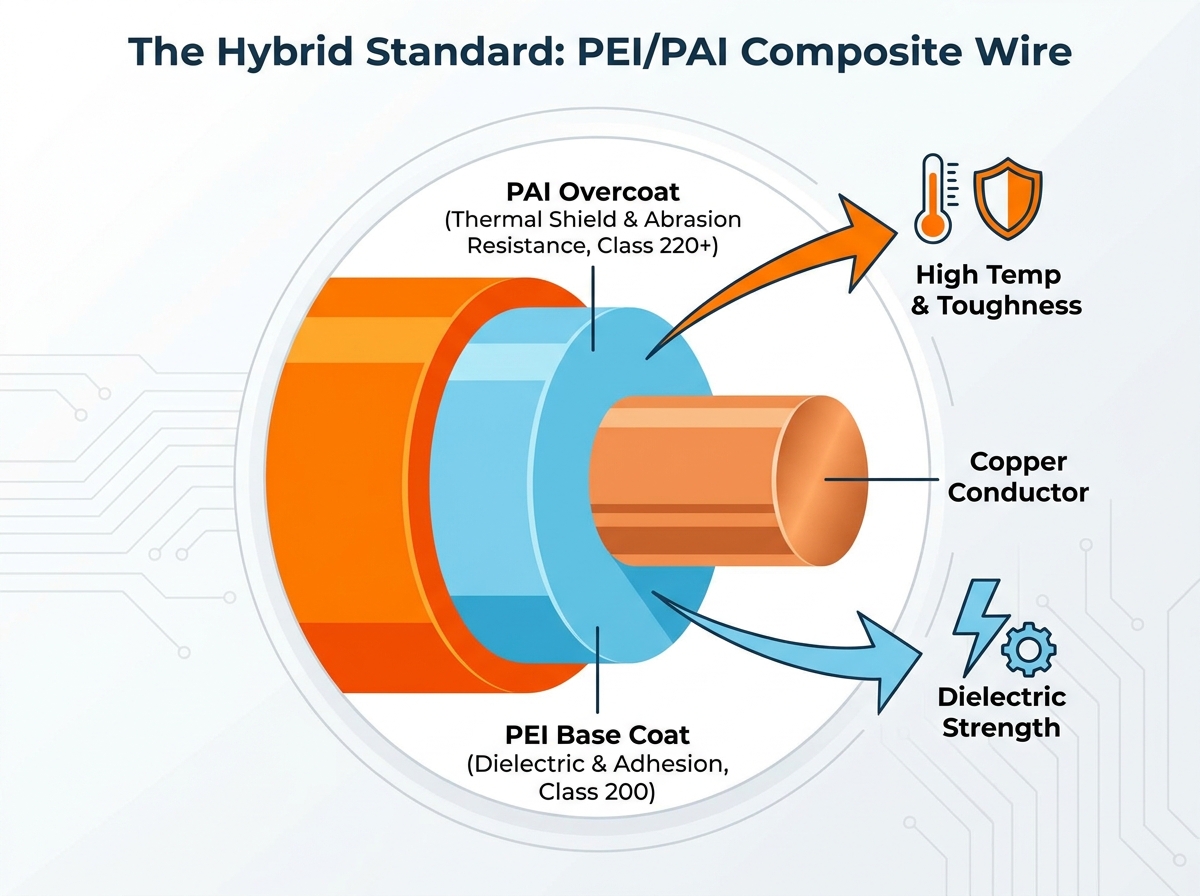
The Composite Standard: In practice, pure PAI is expensive and harder to process; the industry standard (e.g., NEMA MW 35-C) utilizes a PEI base coat for dielectric strength and adhesion, topped with a PAI overcoat for mechanical and chemical protection.
Form Factor Impact: Specification criteria shift significantly when transitioning from round wire to high temperature enameled flat wire due to edge-coverage challenges and hairpin winding stresses.
Understanding the fundamental chemistry of these two distinct resins is crucial. Engineers must evaluate how each polymer reacts under sustained electrical and thermal loads before finalizing a design specification.
Polyesterimide acts as a remarkably robust base layer. The global manufacturing industry relies heavily on it for cost-effective mass production. It provides an excellent foundation for general-purpose electric motors.
Standard Ratings: Standard thermal ratings sit comfortably between 180°C and 200°C.
Electrical Insulation: It boasts excellent baseline dielectric properties under normal operating conditions.
Adhesion: It bonds exceptionally well to bare copper and aluminum conductors.
However, engineers must closely monitor its limitations. PEI shows notable susceptibility to hydrolysis in certain sealed environments. Moisture trapped inside a motor casing degrades the polymer chains over time. It also exhibits lower abrasion resistance compared to top-tier polyamide-imide solutions.
Polyamide-imide serves as a premium, uncompromising protective shield. High-performance applications demand its unique thermal stability. It easily achieves 220°C ratings and handles sudden thermal spikes masterfully.
Thermal Margin: It offers unparalleled thermal headroom for severe overload conditions.
Chemical Defense: This resin delivers superior chemical resistance across the board. It remains completely impervious to most aggressive solvents, impregnating varnishes, and hot automotive fluids.
Implementation reality requires careful strategic planning. Raw material costs run significantly higher. Wire manufacturers must also maintain precise, tightly controlled curing processes. Poor oven curing controls lead to severe wire brittleness. If the enamel becomes brittle, it flakes off instantly during the winding stage.
Thermal ratings mean nothing if the insulation sustains physical damage before the motor even operates. The manufacturing floor represents the most hazardous environment for any magnet wire.
Modern automated winding machinery imposes extreme physical demands. Insertion friction aggressively scrapes the outer enamel layer. Rapid tensioning mechanisms stretch materials to their breaking points. Elongation tests the elasticity of the insulation layer simultaneously.
Here, the exceptional lubricity of PAI enamel wire insulation proves absolutely critical. Its inherent scrape resistance prevents automated tooling from gouging the surface. A smooth PAI topcoat dramatically reduces pinpoint shorts. It stops enamel flaking during continuous, high-speed production runs. This directly improves your factory-floor yield rates.
Specification criteria shift heavily when transitioning away from standard round conductors. Automotive and renewable energy sectors increasingly demand high temperature enameled flat wire. Hairpin motor stators present distinctly unique geometrical challenges.
Edge-build becomes a paramount design concern. Liquid enamel naturally pulls away from sharp corners due to surface tension during manufacturing. Insulation thickness often thins out dangerously on the four corners of rectangular wire. You must specify a highly viscous, structurally sound resin combination to maintain corner coverage. Excellent edge coverage prevents immediate dielectric breakdown when the flat wire bends into tight hairpin shapes.
Wire insulation rarely operates in a pristine vacuum. It constantly battles surrounding chemicals, cooling agents, and secondary manufacturing materials.
Secondary potting compounds and rigid encapsulants interact aggressively with primary wire enamels. Certain impregnating varnishes contain strong solvents. These solvents easily soften weaker single-layer enamels during the baking cycle.
We must analyze continuous performance across diverse, hostile conditions. Hermetic compressor environments expose wires to volatile refrigerants like Freon. Modern EV traction motors utilize aggressive liquid cooling techniques. Automatic Transmission Fluids (ATFs) wash directly over the stator windings. These hot oils contain harsh detergents. Detergents chemically attack and dissolve inferior PEI-only resins over thousands of operating hours.
Engineers need a reliable, standardized testing framework to validate their choices. You should demand comprehensive blister testing data from your supplier. This test reveals the exact solvent absorption rates of the enamel. Additionally, check the retention of dielectric strength post-submersion. Submerging the wire in hot ATF for 1000 hours, followed by a high-voltage test, provides irrefutable empirical safety data.
Operating Environment / Exposure | Pure PEI Resistance | PEI Base / PAI Topcoat |
|---|---|---|
Standard Impregnating Varnishes | Good | Excellent |
Hermetic Refrigerants (R-134a, R-1234yf) | Fair (Risk of Blistering) | Excellent |
Hot Automatic Transmission Fluid (ATF) | Poor (Degradation over time) | Excellent |
High-Moisture Environments (Hydrolysis) | Fair (Susceptible) | Good |
Industry rarely uses these materials in isolation. The most successful engineering applications utilize a composite approach to maximize performance while minimizing excessive raw material expenses.
Specifying a dual-layer system represents the most sound technical decision. It also constitutes a highly logical commercial decision. Pure PAI remains notoriously expensive and difficult to apply perfectly to bare copper.
The resulting synergy is undeniable. PEI provides a highly flexible, high-dielectric base layer. It adheres flawlessly to the conductor. The PAI overcoat acts as rugged, chemical-resistant armor. It protects the sensitive inner layer from mechanical scraping and chemical intrusion. This layered architecture solves multiple engineering dilemmas simultaneously.
Global compliance frameworks map this composite approach meticulously. Procurement teams must understand these designations to avoid costly purchasing errors. Standard misalignment introduces severe operational risks.
Identify the correct NEMA specification. NEMA MW 35-C specifically dictates standards for round copper wire featuring a PEI base and PAI overcoat.
Review NEMA MW 73-C if your project requires aluminum conductors instead of copper.
Locate the IEC equivalent standard. IEC 60317-13 often matches these exact dual-layer specifications for global sourcing.
Confirm regional standard alignment before finalizing international purchase orders.
Procuring the right magnet wire involves strict vendor qualification. You must balance extreme performance requirements against practical sourcing constraints.
Establish strict parameters for your specific application. Zero-fail-tolerance aerospace components easily justify the premium cost for higher PAI thickness. A failed actuator in flight presents unacceptable risks. Conversely, cost-sensitive commercial appliance motors require leaner designs. Over-specifying pure PAI for a simple desk fan wastes valuable project budget. You must align the enamel grade perfectly with the intended application stress.
Application Type | Recommended Specification | Primary Justification |
|---|---|---|
Consumer Appliances | Pure PEI (Class 200) | Cost-sensitive, low mechanical stress during automated winding. |
Industrial Pumps / Generators | PEI / PAI Composite | Requires moderate chemical defense and solid thermal overload margin. |
EV Traction Motors (Hairpin) | Heavy Build PEI / PAI Composite | Demands extreme scrape resistance and ATF chemical immunity. |
Aerospace Actuators | Specialty Heavy PAI | Zero-fail tolerance, extreme temperature fluctuations. |
Always scrutinize manufacturer data sheets carefully. Demand empirical evidence of continuous operating temperature data. Peak spike tolerance alone tells an incomplete story. A wire surviving a three-second 240°C spike might still degrade steadily at a continuous 190°C.
Address underlying supply chain considerations proactively. Monitor lot-to-lot consistency closely. Minor enamel curing variations cause unpredictable field failures. Concentricity tolerances dictate winding success. If the insulation sits off-center, the thin side will short out rapidly. Verify the global availability of your chosen resin formulation to prevent sudden production halts.
Choosing between PEI and PAI is rarely a simple binary choice. It is a highly strategic layering and specification process. Thermal, mechanical, and chemical thresholds dictate your final insulation architecture.
We advise engineers to request detailed standard compliance charts immediately. Ask your vendors for specific NEMA and IEC cross-references. Always request physical test samples. Evaluate these samples for compatibility with your proprietary varnishes and exact winding equipment.
Do not leave high-voltage motor reliability to chance. Encourage your procurement team to contact technical sales. Engineering support can quickly audit your current wire specifications against realistic application loads. Taking this proactive step eliminates costly manufacturing bottlenecks.
A: Yes, but it is rare due to higher costs, adhesion challenges to bare copper, and the fact that a PEI/PAI composite usually meets maximum performance requirements more efficiently.
A: Explain the Arrhenius equation principle—typically, every 10°C reduction in operating temperature below the rated class doubles the insulation lifespan. Operating consistently above the rating slashes durability dramatically.
A: Yes, but for high-frequency voltage spikes (corona discharge), standard PAI must often be modified with inorganic nanoparticles (corona-resistant wire) to survive continuous partial discharge without eroding.